


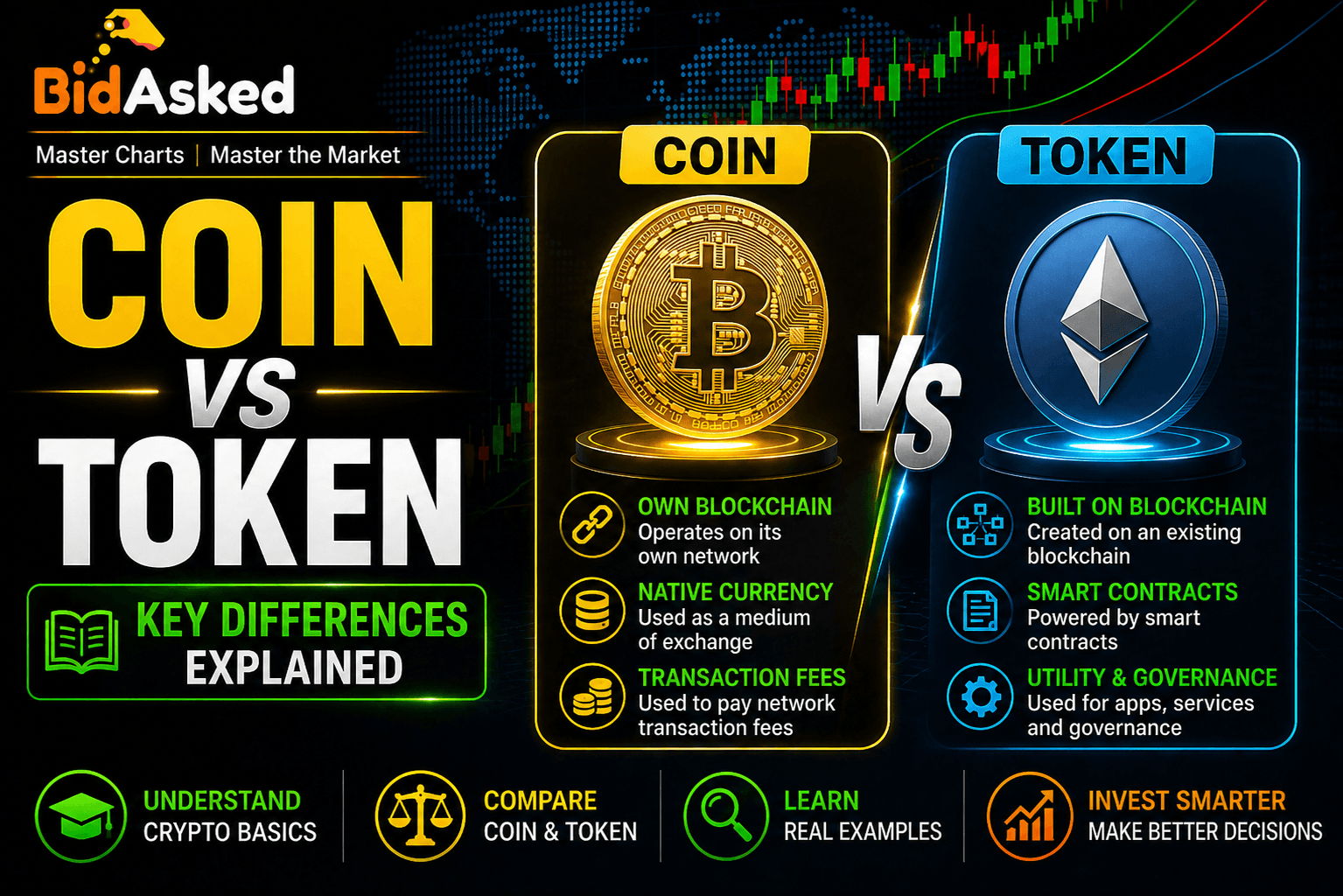
Thousands of digital assets exist in the crypto-currency market, but they are broadly grouped into two main types: coins and tokens. Both coins and tokens use blockchain technology, but they have major differences in their functionality, creation process, intended purpose, blockchain foundation, use cases, and technical design.
Understanding the major differences between coins and tokens is very important for investors, traders, developers, and crypto enthusiasts because it helps them to analyze crypto projects more effectively, assess risks properly, and gain a deeper understanding of the cryptocurrency ecosystem.
What Is A Coin?
In cryptocurrency, a coin is a digital currency that runs on its own separate blockchain network and mainly used for payments, value storage, and financial transactions. Just like traditional currencies used in everyday transactions, cryptocurrency coins are utilized for digital payments on blockchain networks.
A coin is generally considered the original currency of a blockchain. Every blockchain network typically uses its own coin to power the ecosystem, pay transaction charges, reward participants, and support overall network functions.
Cryptocurrency coins were introduced through bitcoin in 2009 by satoshi nakamoto, offering a decentralized way to conduct peer-to-peer transactions without depending on traditional banking systems.
Following the success of bitcoin, thousands of new cryptocurrencies known as altcoins (alternative coins) were introduced to improve faster transactions, lower fees, stronger security, and advanced blockchain functionalities.
What Is A Token?
Tokens are digital assets built on existing blockchain ecosystems and depend on smart contracts for their creation and functionality. Tokens depend on another blockchain to handle security, validation, and infrastructure, making them different from coins that function on independent blockchain networks.
Tokens are generally created for specific purposes within a blockchain ecosystem. They can represent utility functions, access to services, governance rights, digital assets, in-game items, financial products, ownership rights, or reward mechanisms within decentralized applications (dapps). Tokens are widely used across various sectors of the cryptocurrency industry, including decentralized finance (Defi), NFTs, blockchain gaming, metaverse projects, staking platforms, and decentralized autonomous organizations.
Important Key Differences Between Coin And Token In Cryptocurrency:-
Blockchain Ownership
Crypto coins function on independent blockchain platforms that manage their own consensus mechanisms, infrastructure, and transaction validation processes. They are recognized as native blockchain assets.
Unlike coins, tokens do not operate on their own blockchain network. They are built on existing blockchains through smart contracts and depend on the host blockchain for security and infrastructure.
One of the core differences between coins and tokens is blockchain ownership, as it defines how the digital asset is built, secured, maintained, and utilized in the crypto industry.
Primary Purpose
The primary purpose of cryptocurrency coins is to function as decentralized digital money within their own blockchain infrastructure. They help users to make payments, transfer funds, settle transactions, secure the blockchain, and preserve value over time. Coins also play an important role in paying network transaction charges.
On the other hand, tokens are created to serve particular purposes within blockchain ecosystems built on existing networks. Tokens are extensively used in decentralized applications, smart contracts, Defi services, NFT marketplaces, governance voting systems, gaming platforms, and reward programs.
Therefore, coins help to operate their own blockchain infrastructure, while tokens mainly support various platforms, utilities, and ecosystems on other blockchains.
Transaction Fees
Coins are commonly used to pay network fees required for processing transactions on a blockchain. For example, bitcoin (BTC) is used to pay transaction fees and validate transactions on the bitcoin blockchain network.
Tokens generally do not have their own independent blockchain network. instead, they are created and operate on existing blockchains such as ethereum, polygon. As a result, token transactions usually require the native coin of the host blockchain to pay gas fees or network transaction charges.
Investment Perspective
Cryptocurrency coins are considered valuable digital assets because they maintain independent blockchain ecosystems and investor confidence. Whereas, tokens generally represent projects, applications, or ecosystems that are built using established blockchain networks such as Ethereum and Solana. Token value mainly depends on the success and adoption of its project or ecosystem, making it more project specific and potentially higher risk than established coins.
Supply Management
The supply of cryptocurrency coins is mainly controlled by the blockchain protocol and consensus mechanism. New coins are created through mining, staking, or validator rewards, with supply rules predefined in the blockchain network.
In contrast, token supply is managed through smart contracts created by developers. Tokens can be minted, burned, locked, or redistributed based on the project’s tokenomics and programmed rules.
Flexibility
Tokens generally offer greater flexibility than coins because they are built using smart contracts on blockchain networks like Ethereum and Solana. They can be customized for various uses such as Defi, NFTs, staking, gaming, and governance.
Coins are mainly used as digital currencies for payments, transaction fees, and securing their native blockchain networks. Therefore, tokens are usually more adaptable and versatile than coins in real-world blockchain applications.
Network Security
Coins help to secure their own blockchain networks through mechanisms such as mining, staking, or validator participation. Since coins operate on independent blockchains, they play an important role in maintaining network security, transaction verification, and blockchain consensus. Tokens, on the other hand, do not secure separate blockchain networks because they are created on existing blockchains such as Ethereum, Solana, or polygon. Instead, tokens entirely depend on the security infrastructure and consensus mechanism of their host blockchain.
FAQ’S
A cryptocurrency coin works on its own blockchain system, such as bitcoin or ethereum, whereas a token is developed on another blockchain and is often used for decentralized apps, utilities, and smart contract operations.
Bitcoin is recognized as a coin because it uses its own dedicated blockchain network called the bitcoin blockchain.
Crypto tokens are important in blockchain technology because they provide utility, support smart contracts, enable decentralized applications (dapps), and help users to access services, rewards, and governance features within blockchain ecosystems.
Crypto tokens are created on existing blockchain networks because it saves development time, reduces costs, and provides strong security without the need to build a completely new blockchain from scratch.
A cryptocurrency that has its own independent blockchain is called a coin. A cryptocurrency that operates on an existing blockchain network is called a token.
Disclaimer
This article is for educational and informational purposes only and should not be considered financial, investment, trading, legal, or tax advice. Cryptocurrency, blockchain, stock markets, and other financial investments involve risks. Always conduct your own research and consult a qualified financial advisor before making any investment decisions.
