


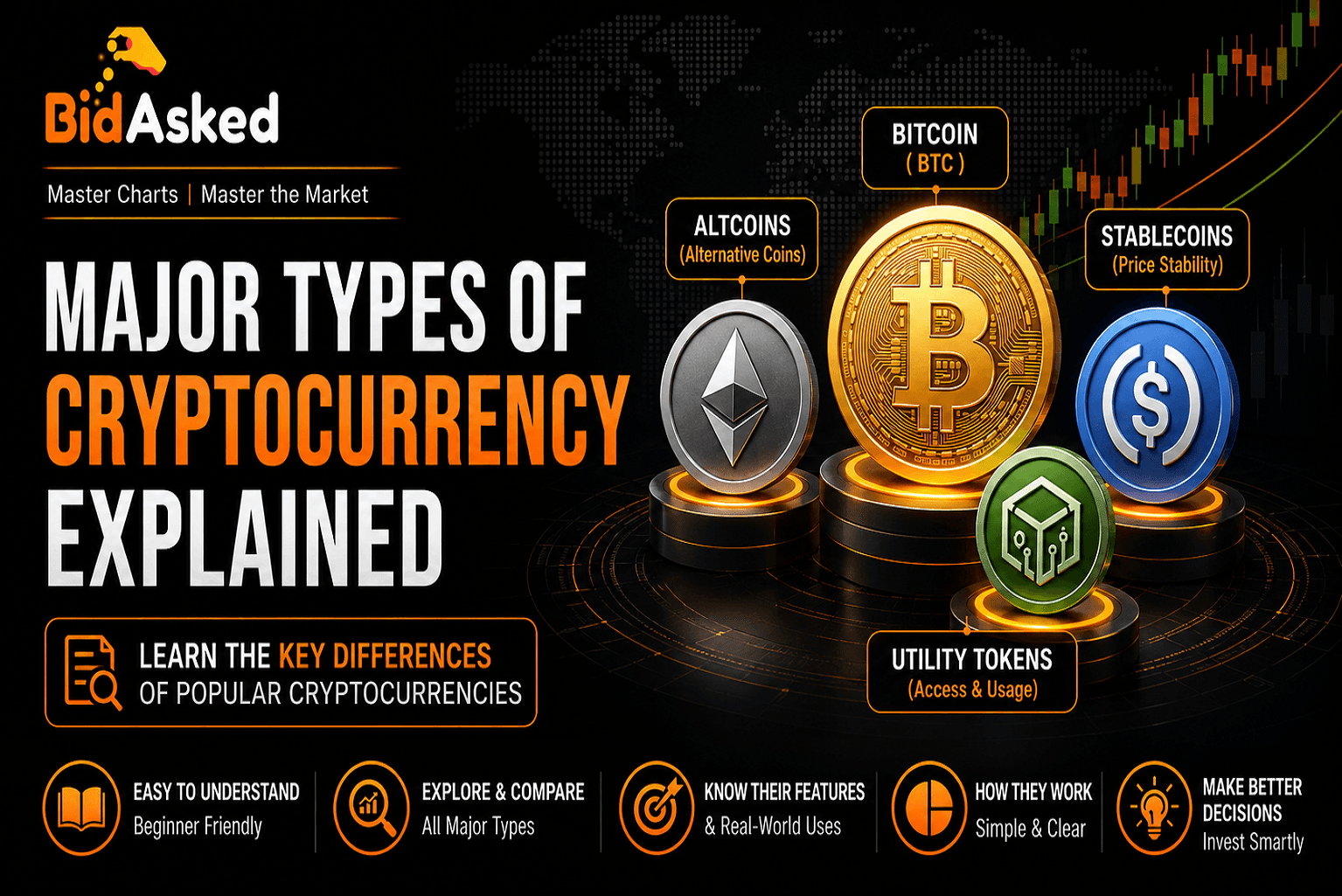
Cryptocurrency is a form of digital currency that uses cryptographic techniques to protect transactions and operates through blockchain technology. Rather than being issued and regulated by governments or central banks like fiat currencies, cryptocurrencies are maintained by decentralised networks of distributed computers. Since the launch of Bitcoin in 2009, cryptocurrencies have redefined digital money through secure, transparent, and borderless peer-to-peer transactions. Today, cryptocurrencies are commonly used for secure digital payments, investment purposes, decentralised finance (DeFi), smart contracts, digital asset ownership, and multiple blockchain-driven applications.
Over time, the cryptocurrency ecosystem has expanded significantly, transforming from one digital currency into thousands of cryptocurrencies with diverse use cases. Some cryptocurrencies focus on serving as digital money, whereas others are developed to facilitate decentralized applications (DApps), smart contracts, DeFi solutions, governance mechanisms, and the ownership of digital and real-world assets.
Before investing or trading, it is important for investors, traders, and beginners to understand the different types of cryptocurrency, as each category serves a unique purpose and has its own features, benefits, risks, and real-world applications. Having a clear understanding of the different types of cryptocurrency helps you make well-informed investment decisions and confidently navigate the expanding blockchain ecosystem. The major categories are explained below:
Bitcoins (BTC):-
Any discussion about the types of cryptocurrency naturally begins with Bitcoin, as it was the first cryptocurrency and laid the foundation for the entire digital asset ecosystem. Most cryptocurrencies developed later were either inspired by Bitcoin or designed to address its limitations.
Bitcoin (BTC), introduced in 2009 by the anonymous creator or group Satoshi Nakamoto, is the first cryptocurrency and the most widely recognized digital asset in the world.
Bitcoin is a decentralized digital currency that enables people to send and receive money directly without depending on banks or other financial institutions. It operates through blockchain technology, a transparent and decentralized ledger that securely maintains transaction records across a distributed network.
The fixed supply of 21 million BTC is one of bitcoin’s unique features, making it a digitally scarce asset with limited availability. Due to its fixed supply, bitcoin is widely regarded by many investors as a potential long-term store of value, even though its market price is known for significant volatility.
Bitcoin allows users to transfer funds across borders without the involvement of conventional banking institutions, making it a global digital payment system. Because of its scarce supply, decentralized design, and growing acceptance worldwide, it is often referred to as “digital gold.”
Key Characteristics Of Bitcoin (BTC):
- Limited supply: Because its total supply is restricted to 21 million BTC, Bitcoin is widely recognized as a scarce digital asset.
- Decentralized: Built on decentralized blockchain technology, Bitcoin allows users to transact directly without intermediaries.
- Globally recognized: Bitcoin is the most recognized and commonly used cryptocurrency across the world.
- Store of value: Many investors consider Bitcoin a potential long-term store of value due to its limited supply and growing adoption.
- Secure: Protected by blockchain technology and the proof of work (PoW) consensus mechanism.
Altcoins:-
The term “Altcoin” stands for “alternative coin” and refers to any cryptocurrency other than Bitcoin. The altcoin ecosystem is where much of the innovation in the cryptocurrency industry takes place. Most altcoins were created to overcome Bitcoin’s limitations or introduce new features, functionalities, and use cases.
While the primary purpose of bitcoin is to function as a digital currency and store of value, many altcoins offer innovative features such as smart contracts, decentralised applications, quicker transaction processing, lower network fees, enhanced privacy, and specialized blockchain capabilities.
The first major altcoin was Lite-coin (LTC), introduced in 2011 by Charlie Lee as a faster and more lightweight alternative to Bitcoin, featuring quicker transaction confirmations and a maximum supply of 84 million coins. Launched in 2015, Ethereum is the most influential altcoin by market capitalization and ecosystem impact, although it has grown beyond the traditional altcoin category and is now regarded as a distinct cryptocurrency class.
Other well-known altcoins include XRP, Cardano (ADA), Solana (SOL), Avalanche (AVAX), and Polkadot (DOT). Every altcoin is built around a unique blockchain concept, ranging from efficient payment systems to advanced smart contract platforms and cross-chain interoperability. Today, the cryptocurrency market includes thousands of altcoins, each designed to support specialized functions such as decentralised finance (Defi), gaming, digital identity, supply chain management, artificial intelligence (AI), and tokenized assets.
Popular Altcoins And Their Uses:-
Ethereum (ETH):
Ethereum (ETH) is the second-largest cryptocurrency by market capitalization and popularized smart contracts, which are self-executing agreements that automatically execute when predefined conditions are met. It acts as the foundation for thousands of decentralised applications (DApps), decentralised finance (Defi) platforms, and non-fungible token (NFT) projects, making it one of the world’s most widely used blockchain networks.
Solana (SOL):
Solana is a high-performance blockchain known for its fast transaction speeds and low transaction fees. Designed for scalability, it enables developers to build decentralised applications (DApps) efficiently and is widely used in decentralised finance (DeFi), blockchain gaming, NFT marketplaces, and other web3 applications.
Cardano (ADA):
Cardano (ADA) is a blockchain platform developed using a research-driven and peer-reviewed approach. It is designed to provide a secure, scalable, and sustainable infrastructure for smart contracts and decentralised applications (dapps), enabling use cases such as decentralised finance (Defi), digital identity, and blockchain-based services.
XRP:
XRP is a cryptocurrency that operates on the XRP ledger and is designed to enable fast, low-cost cross-border payments. It is used in payment-focused blockchain solutions to improve the speed and efficiency of international money transfers. Due to its fast transaction processing and relatively low transaction fees, XRP is commonly used for global payment and remittance services.
Stablecoins:-
Stablecoins are cryptocurrencies specifically designed to maintain a relatively stable market value. While bitcoin and most cryptocurrencies often experience sharp price fluctuations, stablecoins seek to minimize volatility by linking their value to an underlying asset through a peg or stabilization mechanism, including fiat currencies, commodities, or other cryptocurrencies.
Because they maintain a relatively stable value, stablecoins are widely used for digital asset trading, cross-border payments, decentralised finance (DeFi), and preserving capital during periods of high market volatility.
Primary Features:
- Widely used for cryptocurrency trading, international payments, and financial settlements.
- Their value is typically pegged to or backed by assets such as fiat currencies (e.g., the US dollar), gold, or other cryptocurrencies.
- Often used to enable lending, borrowing, and liquidity management within decentralised finance (Defi) networks.
- Minimal price fluctuations compared to most cryptocurrencies.
Examples of stablecoins include:
- Tether (USDT)
- USD coin (USDC)
- DAI
Types Of Stablecoins Include:-
Fiat-Backed Stablecoins:
The stability of fiat-backed stablecoins is derived from reserves of government-issued currencies, such as the U.S. dollar, the euro, and other fiat currencies, held by the issuer or trusted custodians. These reserves are maintained to back the circulating supply of the stablecoin and help to maintain its peg to the underlying fiat currency. Stablecoins such as USDT (tether) and USDC (USD coin) are backed primarily by U.S. dollar-denominated reserves and are designed to maintain a value of approximately 1 U.S. dollar per coin.
Crypto-Backed Stablecoins:
Crypto-backed stablecoins are supported by reserves of other cryptocurrencies as collateral. Because the underlying cryptocurrencies can be highly volatile, crypto-backed stablecoins generally maintain excess collateral, ensuring their value remains greater than the stablecoins issued. This extra collateral provides protection against price fluctuations, ensuring the stablecoin remains stable in value. Many crypto-backed stablecoins use smart contracts that continuously monitor and maintain the necessary collateral ratio. Examples are: DAI
Algorithmic Stablecoins:
Algorithmic stablecoins attempt to maintain their price peg through smart contracts and automated supply & demand mechanisms rather than relying primarily on collateral reserves. Algorithmic stablecoins have faced major collapses in the past, leading to concerns about their ability to maintain long-term stability. Therefore, they are typically considered riskier than fiat-backed stablecoins. Examples: TerraUSD (UST), which collapsed in 2022.
Commodity-Backed Stablecoins:
These stablecoins are supported by physical assets such as gold, silver, or other valuable commodities. These stablecoins derive their value from the market price of the underlying asset.
A gold-backed stablecoin may represent a specific amount of physical gold stored in secure reserves, providing holders with ownership rights or redemption claims. Example: Pax Gold (PAXG).
Utility Tokens:–
Utility tokens are digital currencies that give users the right to access products, services, or platform functionalities within a blockchain network. Their primary purpose is to provide specific utility rather than function as a medium of exchange or an investment. Utility tokens allow users to access decentralised applications (DApps), pay platform-related fees, unlock ecosystem features, and, in some blockchain ecosystems, participate in governance. Common examples of utility tokens are Chainlink (link), used for decentralised oracle services, and Filecoin (fil), which supports decentralised file storage. Utility tokens are typically launched through initial coin offerings or token generation events to raise funds for blockchain-based projects.
Key characteristics of utility tokens:
- Utility tokens allow holders to use blockchain-based services, applications, and platform-specific features.
- Utilized within a blockchain ecosystem to access specific features, products, or services.
- Support decentralised applications (DApps) by enabling transactions, payments, or access to services.
- Utility token prices may benefit from increased platform usage and demand, although future value growth remains uncertain.
Examples of utility tokens:
- Chainlink (link): Primarily used to reward node operators for supplying accurate and trustworthy real-world data to smart contracts through oracle networks.
- BNB: Primarily used in the Binance ecosystem for paying trading fees, participating in token launches, and utilizing various platform services.
- Basic Attention Token (BAT): Used within the Brave browser ecosystem to reward users, content creators, and advertisers while supporting a privacy-focused digital advertising ecosystem.
Governance Token:-
Governance tokens are digital cryptocurrencies that allow holders to participate in the governance and decision-making of a blockchain network or decentralised application (DApps). Rather than depending on a central authority, governance token holders can vote on proposals involving protocol upgrades, treasury management, transaction fee models, incentive programs, and the introduction of new features. These tokens are commonly used in decentralised finance (DeFi) platforms and decentralised autonomous organizations (DAOs), where community members collectively help govern the project.
Key features:
- Enable token holders to participate in voting on protocol proposals
- Promote transparent and decentralized decision making across the blockchain network
- Strengthen community engagement by allowing token holders to influence governance decisions
- Support higher levels of transparency and accountability across decentralised platforms
Examples:
- Uniswap (UN)
- Maker (MKR)
- Aave (AAVE)
- Compound (COMP)
Meme Coins:-
Meme coins are cryptocurrencies created based on internet memes, jokes, online communities, or viral social media trends. Although meme coins originated as humorous or entertainment-driven projects, some have experienced remarkable growth, gained widespread recognition, and achieved significant market capitalizations.
While Bitcoin and many utility-focused cryptocurrencies derive value from their underlying technology and use cases, meme coins often depend more on community support, social media influence, celebrity endorsements, and overall market sentiment. However, several meme coin projects have gradually evolved by expanding their ecosystems to include features such as staking, decentralised finance (DeFi), NFT integration, blockchain gaming, and various decentralised applications.
Despite their increasing popularity, meme coins are widely regarded as highly speculative and extremely volatile investment assets. Their prices are highly influenced by online hype, investor sentiment, social media activity, and overall market conditions rather than intrinsic value or practical real-world adoption. Therefore, investors should carefully evaluate the potential risks and perform comprehensive research before investing in meme coins.
Some of the most well-known meme coins include Dogecoin (DOGE), Shiba Inu (SHIB), Pepe (PEPE), Floki, and Bonk. Among these, Dogecoin is the oldest and one of the most widely recognized meme coins.
Dogecoin (DOGE):
Dogecoin (DOGE) was established in December 2013 as a humorous digital asset inspired by the internet-famous “DOGE” meme featuring a Shiba Inu dog. Despite its beginnings as a parody cryptocurrency, Dogecoin has grown into one of the most widely recognized, widely adopted, and actively traded digital assets in the global cryptocurrency market.
Since it was launched, Dogecoin has gained widespread popularity due to its active community, strong social media support, and increasing popularity in the cryptocurrency market. Over time, Dogecoin has expanded beyond its status as a meme coin by supporting online tipping, charity fundraising, and digital payment transactions, demonstrating the evolving utility of some meme coin projects
Potential risks of meme coins:
Despite their potential to generate significant returns, meme coins come with a high level of risk that investors should carefully consider before investing. Some of the most important risks include.
- Meme coins are known for significant and unpredictable price swings that can occur in a very short time.
- Their values are largely driven by social media trends, viral content, active community support, and endorsements from celebrities or influencers.
- Many meme coins have few practical use cases compared to established cryptocurrencies and blockchain projects.
- Meme coin prices are largely determined by investor sentiment and market speculation instead of significant technological innovation or strong underlying fundamentals.
- Certain meme coin projects may lose momentum as user interest fades, development slows, and adoption decreases over the long run.
FAQ’S
Answer: There is no fixed number of cryptocurrency types, as they are classified into categories such as coins, altcoins, stablecoins, utility tokens, meme coins, and others based on their purpose, technology, and use cases.
Answer: Bitcoin is the most popular and widely recognized cryptocurrency. As the world’s first decentralised digital currency, it is known for its large market capitalization, strong security, and widespread adoption.
Answer: Understanding different cryptocurrency types enables investors to make better financial decisions by evaluating their features, risks, and long-term potential.
Answer: Before choosing a cryptocurrency type, investors should evaluate its purpose, underlying technology, market demand, risk level, real-world use cases, and long-term growth potential.
Answer: No, not all cryptocurrencies are used for payments. Many are designed for governance, decentralised finance (Defi), gaming, NFTs, staking, or providing utility and services within blockchain ecosystems.
Disclaimer
This article is for educational and informational purposes only and should not be considered financial, investment, trading, legal, or tax advice. Cryptocurrency, blockchain, stock markets, and other financial investments involve risks. Always conduct your own research and consult a qualified financial advisor before making any investment decisions.
