


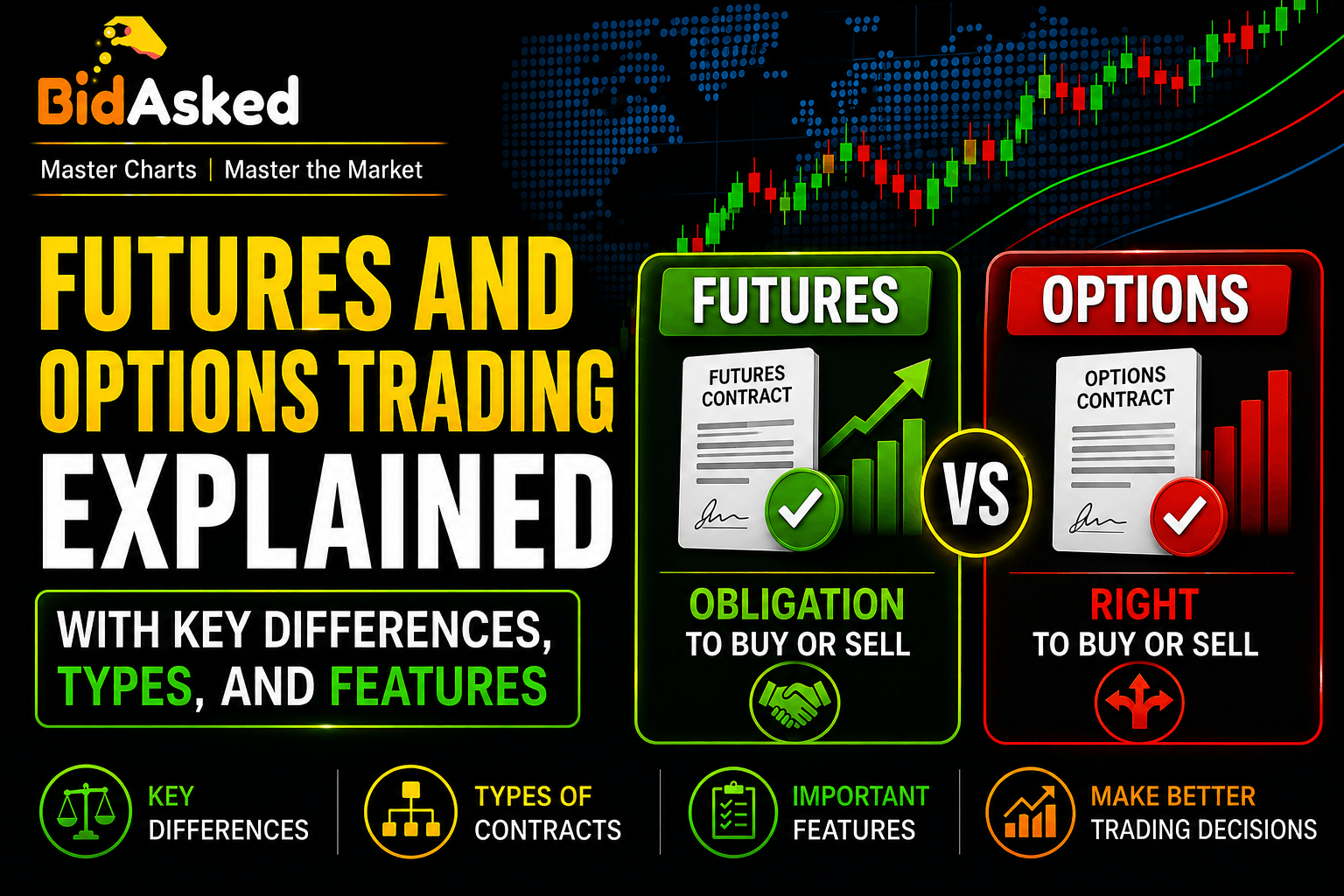
What Are Futures And Options (F&O)?
The futures and options (f&o) market is a part of the derivatives market where traders and investors trade derivative contracts rather than buying or selling the actual underlying asset. The value of these contracts is based on underlying assets, including stocks, stock indices, commodities, currencies, and other financial instruments. In the cash market, ownership of the asset is transferred to the buyer, whereas futures and options trading is based on agreements tied to the future price fluctuations of an underlying asset. It is widely used for hedging against risk, speculation, and arbitrage, making it an essential component of modern financial markets.
The derivative market is a segment of the financial market in which contracts are bought and sold based on the value of an underlying financial asset. In the f&o market, participants trade contracts linked to an underlying asset, and the value of these contracts changes as the underlying asset’s price rises or falls. The derivatives market is designed to help investors hedge against financial risks, increase market liquidity, and contribute to fair and efficient price discovery.
Futures and options (f&o) are the two most commonly traded forms of derivative contracts in the financial markets. A futures contract is a formal legal agreement that binds the buyer and seller to buy or sell an underlying asset at a fixed price on a specified future date. In an options contract, the buyer has the right, but not the obligation, to purchase or sell the underlying asset at a fixed price before or on the expiry date, while the seller is obligated to fulfil the contract if the buyer chooses to exercise the option. Although futures and options derive their value from the same underlying asset, they are fundamentally different in terms of their rights, obligations, risk management, and trading strategies.
The primary purpose of futures and options is to manage market risk, profit from anticipated price movements, and benefit from arbitrage opportunities. These derivative contracts help investors reduce the impact of adverse price movements, whereas traders use them to capitalise on both upward and downward market trends. They also offer leverage, enabling traders and investors to control larger market positions with a relatively small capital investment, making futures and options an effective tool for both investing and managing risk.
Every f&o contract is created around an underlying asset, and any change in the asset’s price directly impacts the value of the derivative contract. Common examples of underlying assets are stocks, indices, commodities, and currencies. As the price of the underlying asset changes, the value of the futures or options contract also changes accordingly.
What Is A Futures Contract?
A futures contract is one of the most actively traded derivative instruments in the global financial markets. It is a standardised legal agreement in which two parties agree to buy or sell a specific underlying asset at a predetermined price on a specified future date. A futures contract is traded on a recognised stock or commodity exchange, providing greater transparency and minimising counterparty risk.
In this agreement, the buyer accepts the obligation to buy the asset in the future, while the seller agrees to deliver the underlying asset or make a cash settlement based on the contract specifications. Typically, traders do not hold futures contracts until settlement, choosing instead to exit their positions before the expiry date.
The value of a futures contract changes according to the price movement of the underlying asset, such as stocks, stock indices, commodities, or currencies. As the price of the underlying asset changes, the value of the futures contract also changes accordingly. This mechanism allows participants to generate returns from both upward and downward price trends without receiving physical delivery of the underlying asset at the time of the trade. Instead of purchasing the underlying asset directly, traders can enter a futures contract by paying an initial margin, allowing them to gain exposure to a much larger contract value using leverage.
The basic concept behind a futures contract is securing a predetermined price for a future transaction. From the moment the contract is executed, both the buyer and seller are obligated to honour the agreed conditions irrespective of market fluctuations. Consider an investor who predicts that a company’s stock price will rise over the next month. Rather than purchasing the shares directly, the investor can secure a futures contract at today’s predetermined price. If the stock price moves up as expected, the futures contract generally gains value, enabling the investor to potentially earn a profit. Similarly, a trader who expects the stock price to decline may sell a futures contract initially and buy it back later at a lower price, earning a profit if the price drops.
In the derivatives market, futures contracts are mainly used for hedging, speculation, and arbitrage. Businesses depend on them to manage price risk, while traders use them to benefit from short-term fluctuations in market prices.
How Does A Futures Contract Work?
A futures contract operates through a standardised process where buyers and sellers enter into a legally binding agreement on a recognised stock exchange. The exchange acts as an intermediary and guarantees settlement, ensuring that both parties fulfill their contractual obligations.
A futures contract is defined by standardised specifications such as the underlying asset, contract size, expiration date, tick size, and settlement process. Since these specifications are predetermined by the exchange, traders only negotiate the contract price.
Every trading day, profits and losses in futures contracts are adjusted using the mark-to-market (MTM) mechanism based on daily price movements. If the market moves in your favour, the profit is added to your margin account; however, if the market moves against your position, the corresponding loss is debited from your margin account.
Important Key Features Of A Futures Contract
- Standardised contract: futures contracts have fixed rules, such as contract size, expiry date, and other terms, which are decided by the exchange.
- Used for hedging and speculation: futures are commonly used to manage price risk as well as speculate on future price movements.
- Obligation to buy or sell: both the buyer and seller are required to fulfil the contract according to its terms.
- Daily mark-to-market settlement: profits and losses are generally settled daily based on changes in the contract price
- Leverage: futures allow traders to control a large position with comparatively less capital
- High risk: because of leverage, losses can be substantial if the market moves against the position
What Is An Option Contract?
An option contract is a financial derivative that gives the buyer the right, but not the obligation, to buy or sell an underlying asset at a predetermined price on or before its expiration date, depending on its exercise style. Futures contracts impose obligations on both parties, whereas option contracts give the buyer the flexibility to exercise the right or allow the option to expire.
An option contract derives its value from an underlying asset, such as a stock, stock index, commodity, or currency, which makes it a derivative instrument. In the Indian market, options are traded through recognised exchanges such as NSE and BSE, with standardised contract terms established by each exchange.
Options are widely used by traders and investors to hedge market risk, generate income through specific strategies, and speculate on future price movements. Options can provide exposure to an underlying asset by paying a relatively small premium instead of purchasing the asset directly, allowing traders to use leverage. However, leverage can significantly increase the impact of price changes on an option’s value, so traders should understand the associated risks before entering options trades.
An option contract allows the buyer to gain exposure to an underlying asset while keeping the maximum possible loss limited to the premium paid, excluding applicable transaction charges. Depending on the strategy used, options can be used to potentially benefit from rising markets, falling markets, or even sideways market conditions.
How Does An Option Contract Work?
Every option contract includes two main parties: the option buyer and the option seller. Purchasing an option contract requires the buyer to pay a fee called the option premium. After paying the premium, the buyer obtains the right to execute a buy or sell transaction in the underlying asset at the predetermined strike price before or on the contract’s expiration date, according to the option selected.
The seller, also called the option writer, receives the option premium in exchange for bearing the contractual obligations. Whenever the buyer exercises the option contract, the seller has a legal obligation to meet the agreed contractual conditions. The buyer may decide not to exercise the option when market conditions are unfavourable, in which case the contract expires, and the seller keeps the premium. This unique structure, where the buyer has a right but not an obligation, is what differentiates option contracts from futures contracts.
Every option contract includes key details such as the underlying asset, strike price, expiration date, contract size (lot size), and the option premium. By standardising contract specifications, the exchange ensures that buyers and sellers can trade efficiently without the need for separate negotiations. This standardisation improves market liquidity, increases transparency, and makes trading more efficient.
An option contract limits the buyer’s maximum loss to the premium paid, while an uncovered (naked) option seller may face substantial or, in some cases, theoretically unlimited losses. By offering leverage, option contracts allow traders to take larger market positions with relatively low capital, enhancing both return potential and overall risk.
Each option contract has a specified expiration date, beyond which it cannot be exercised. As an option approaches its expiration, theta steadily reduces its time value (extrinsic value), especially when the underlying asset’s market price remains unchanged.
Types Of Option Contracts
In the options market, contracts are broadly divided into two types: call options and put options. These options are used to profit from expected upward or downward price movements.
Call Options:-
A call option gives the buyer the right, but not the obligation, to buy the underlying asset at the predetermined strike price on or before the expiration date. Traders generally buy call options when they expect the price of the underlying asset to rise. Whenever the market price exceeds the strike price, the intrinsic value of the call option generally increases, allowing the buyer to earn gains from the favourable price movement. On the other hand, when the market price remains below the strike price until expiration, the option may become worthless, with the buyer losing only the premium.
Example
Current stock price = ₹800
Strike price = ₹850
Premium paid = ₹18
If the stock price rises to ₹920 before expiry, the buyer has the right to purchase the stock at ₹850 instead of ₹920. The profit is determined by subtracting the premium paid from the difference between the market price and the strike price.
Call options are commonly used by traders who have a bullish outlook on the market.
Put Option:-
A put option gives the buyer the right, but not the obligation, to sell the underlying asset at the predetermined strike price on or before the expiration date. Traders usually purchase put options when they anticipate a decline in the market price. When the market price declines below the strike price, a put option typically gains value. If prices increase instead, the buyer may simply allow the option to expire, limiting the loss to the premium paid.
Example:
Suppose the shares of ABC Ltd. are trading at ₹1200. A trader expects the stock price to fall and buys a put option.
Current stock price = ₹1200
Strike price = ₹1180
Premium paid = ₹20
If the stock price falls to ₹1100, the put option gains value because it gives the buyer the right to sell the underlying asset at ₹1180 instead of the prevailing market price of ₹1100. This allows the buyer to earn a profit after deducting the premium paid.
However, if the stock price rises above ₹1180, the trader will not exercise the option and will lose only the ₹20 premium paid.
This is why traders buy put options when they expect the market to decline.
Together, call and put options give traders the flexibility to navigate both upward and downward market trends, providing greater flexibility for managing trades and reducing market risk through hedging.
Important Key Features Of An Options Contract
- Right without obligation: the option buyer has the right, but not the obligation, to buy or sell the underlying asset according to the contract terms
- Strike price: every option has a predetermined price at which the underlying asset can be bought or sold according to the contract
- Option premium: the buyer pays a premium to obtain the rights provided by the option contract
- Potentially high risk for seller: an option seller receives the premium but takes on an obligation and can face substantial losses depending on the position
- Time decay: the time value of an option generally decreases as the expiry date approaches, all else being equal
- Fixed expiry date: options have a specific expiry date after which the contract ceases to exist
- Limited risk for buyer: the maximum loss for an option buyer is generally limited to the premium paid
Key Differences Between Futures And Options
The following table highlights the key differences between futures and options
| Basis | Futures | Options |
| Definition | A contract that requires the buyer and seller to complete a transaction for an underlying asset at a fixed price on a specified future date. | A contract that gives the buyer the right, but not the obligation, to purchase or sell an underlying asset at a predetermined price. |
| Types | Types of futures contracts are based on an underlying asset or market index. | The major types of options include call options and put options. |
| Rights and obligations | Create a binding obligation for both the buyer and seller. | The buyer has the right, while the seller has the obligation if the contract is exercised. |
| Time decay | Futures have no direct time decay component affecting contract value. | Time decay can reduce the value of an option as expiry approaches. |
| Margin requirement | Both buyers and sellers generally need to maintain margin. | Option buyers generally pay the premium; option sellers generally need to maintain margin. |
| Profit potential | Futures may generate substantial profits depending on how the price of the underlying asset moves. | Profit potential depends on the option type, price movement, strike price, premium paid, time to expiry, and market volatility. |
| Maximum loss | The potential loss is substantial and depends on the position size and direction of price movement. | Option buyers usually have a maximum loss equal to the premium paid, while option sellers can face much higher and potentially unlimited losses. |
Leverage | Offers leverage in futures by allowing traders to control larger positions with margin. | Options can offer significant leverage because the premium paid is usually much smaller than the value of the underlying asset. |
| Expiry | Has a fixed expiry date. | Has a fixed expiry date. |
| Hedging | Used as a strategy to protect against price uncertainty. | Commonly used to manage price risk with greater flexibility. |
| Complexity | Generally simple to understand and manage. | Generally more complex because several factors influence option value. |
| Best used for | Directional trading, hedging, and managing price exposure. | Hedging, speculation, and advanced trading strategies. |
FAQ’S
Answer: Futures and options are derivative contracts whose value is based on an underlying asset such as stocks, indices, commodities, or currencies.
Answer: The key difference between futures and options is that futures create an obligation to buy or sell an asset at a predetermined price, while options give the buyer the right but not the obligation to buy or sell it.
Answer: Yes, futures and options contracts have a specified expiry date according to the contract and exchange specifications.
Answer: Options are mainly divided into call options, which give the right to buy an asset, and put options, which give the right to sell an asset at a specified price before or on the expiration date.
Answer: The strike price is the predetermined price at which the buyer can exercise an option to buy or sell the underlying asset, depending on whether it is a call or put option.
Answer: The option premium is the price paid by the buyer to purchase an options contract.
Disclaimer
This article is for educational and informational purposes only and should not be considered financial, investment, trading, legal, or tax advice. Cryptocurrency, blockchain, stock markets, and other financial investments involve risks. Always conduct your own research and consult a qualified financial advisor before making any investment decisions.
