


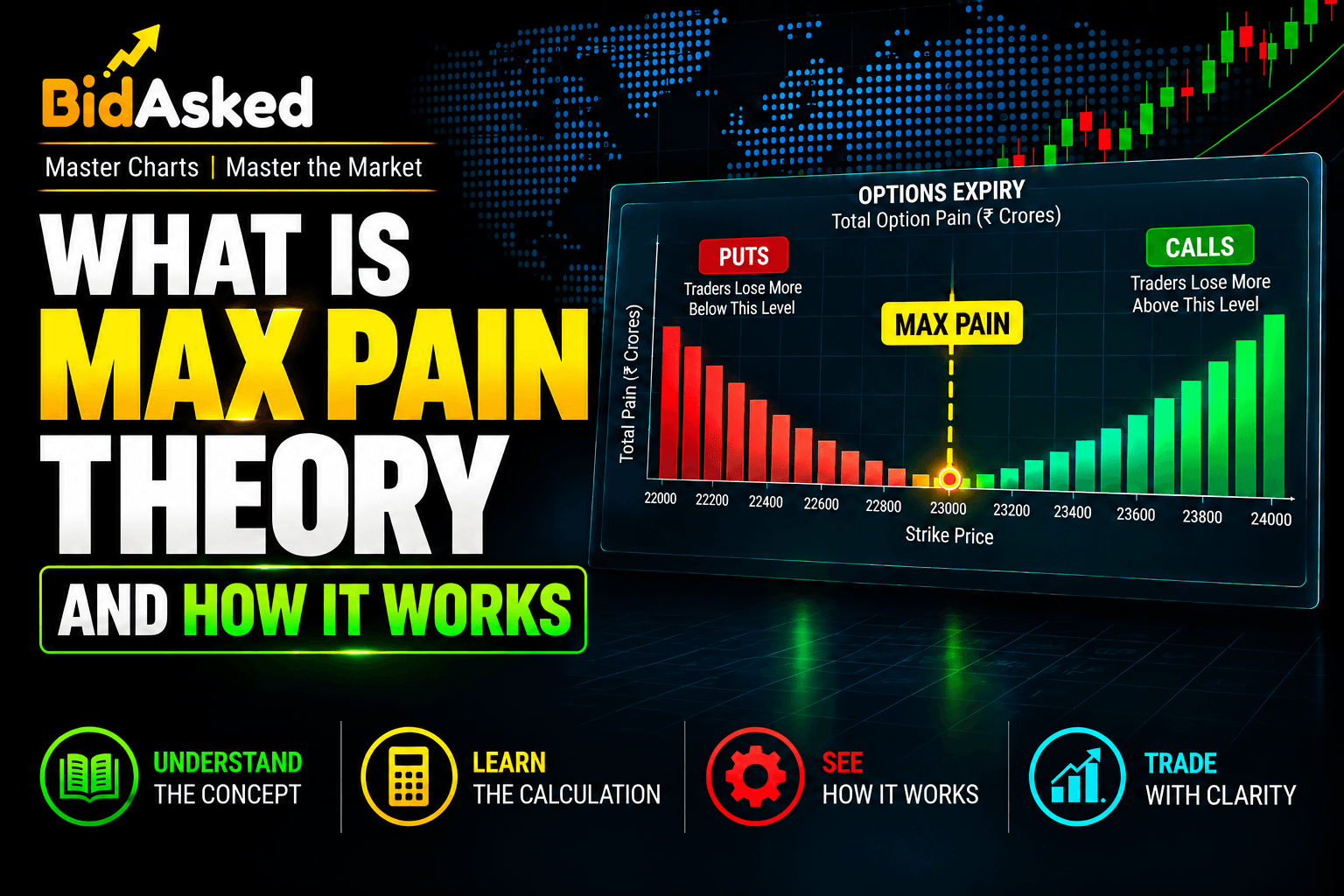
What Is Max Pain Theory?
In options trading, Max Pain Theory identifies the strike price at which the combined intrinsic value of outstanding call and put options is minimized at expiry. This strike price is often referred to as the max pain price or maximum pain point.
Max pain theory is commonly determined by studying call and put open interest (OI) across multiple strike prices for a specific options expiry. It considers the intrinsic value that would be payable to option holders at different possible expiry levels.
As the options expiry date approaches, the theory indicates that the underlying asset price may move closer to the strike price where option holders receive the lowest aggregate intrinsic value payout. If the underlying price settles around this level at expiry, the combined intrinsic value payable to option holders would generally be lower.
However, Max Pain is a theoretical concept, not a guaranteed prediction of the market price. The underlying asset may expire either above or below the max pain level because various factors, including market sentiment, news, volatility, demand and supply, can influence its price.
How Max Pain Theory Works
Max pain theory works by analyzing the open interest (OI) of call and put options across different strike prices for a specific expiry date. It estimates the total theoretical payoff that option buyers would receive at various possible expiry prices.
The process typically consists of the following steps:-
- Collect call and put OI: Identify the open interest (OI) of call and put options across different strike prices for the selected expiry.
- Evaluate various expiry levels: Analyze various prices at which the underlying asset may settle on expiry.
- Calculate option payoffs: Determine the intrinsic value of in-the-money call and put options at each assumed expiry price, considering their open interest.
- Calculate total payoff: Calculate the total theoretical payoff of call and put options for each possible expiry price.
- Identify the max pain price: Compare the theoretical payoffs across possible expiry prices and identify the level with the minimum total payoff.
Example of max pain calculation:-
Suppose the calculated total theoretical payoffs for different expiry prices are as follows:
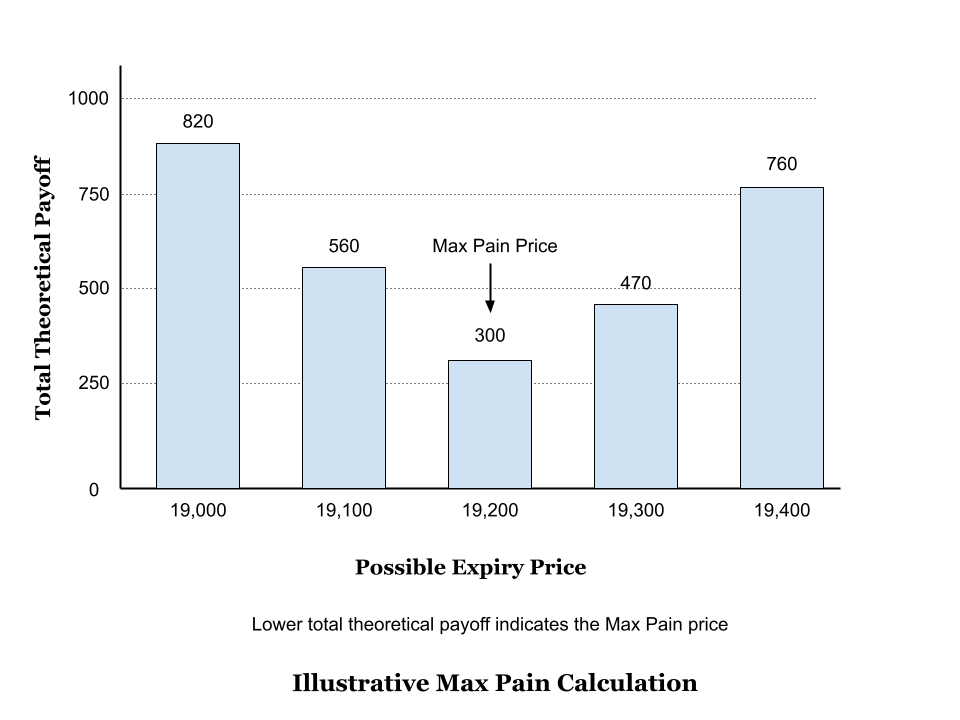
In this example, 19,200 has the lowest total theoretical payoff. Therefore, 19,200 would be identified as the max pain price for that particular expiry.
The basic working principle of max pain theory is to identify the price level that minimizes the combined intrinsic value payoff of outstanding call and put options. This level is used as a theoretical reference in options analysis and is not a certain indication of where the underlying asset will expire.
Max pain can change when open interest, option positions, and market prices change. The actual expiry price may trade above or below the max pain level due to market trends, news, volatility, demand & supply, and other market factors.
Advantages Of Max Pain Theory
- Helps to determine a potential expiry level: Indicates the strike price where the total theoretical payout across calls and puts is lowest.
- Useful near expiry: Helps traders to analyze option positions and potential price trends as the expiry date gets closer.
- Supports multi-tool analysis: Traders can use max pain alongside PCR, price action, support & resistance, trading volume, and changes in open interest for a more comprehensive analysis.
- Uses open interest data: Helps traders analyses the distribution of call and put open interest (OI) across different strike prices.
- Simple to interpret: Traders can compare the current market price with the max pain level to see the difference from the theoretical expiry level.
Disadvantages Of Max Pain Theory
- No assurance of expiry price: The market may expire well above or below the calculated max pain level.
- Can give misleading signals: Using max pain alone to make trading decisions may produce misleading results.
- Overlooks external market factors: Changes in news, investor sentiment, institutional activity, volatility, and economic conditions can significantly affect prices but are not reflected in max pain theory.
- Does not indicate price manipulation: The existence of a max pain level does not necessarily mean that option sellers or other market participants are intentionally influencing the price toward it.
FAQ’S
Answer: Max pain theory works by analyzing call & put open interest across different strike prices to identify the price level where option buyers would theoretically experience the maximum loss at expiration.
Answer: Max pain theory is used to find the price level where option buyers may face the highest overall loss at expiry, helping traders to understand possible price movements near expiry.
Answer: The max pain point indicates a theoretical expiry level where the total payout to option holders would be at its minimum.
Answer: No, max pain cannot determine the actual expiry price; it only represents a theoretical level derived from option chain data.
Answer: Yes, max pain theory can be useful near options expiry because it helps traders to identify the strike price where the combined option holders may experience the maximum theoretical loss, based on open interest.
Disclaimer
This article is for educational and informational purposes only and should not be considered financial, investment, trading, legal, or tax advice. Cryptocurrency, blockchain, stock markets, and other financial investments involve risks. Always conduct your own research and consult a qualified financial advisor before making any investment decisions.
