



What Are Option Greeks?
Option Greeks are mathematical indicators used by options traders to measure how changes in different market factors can affect an option’s price. They help traders to understand why an option’s premium changes and estimate how much its price may change when market conditions change.
Option Greeks help to measure the impact of changes in the underlying asset price, time to expiry, volatility, and interest rates on an option’s premium. They provide valuable insights into the potential risks and price changes of an options position before entering into a trade.
Option Greeks are important because the premium of an option is determined by multiple factors, not simply by whether the underlying asset rises or falls. Time decay, volatility, and interest rates can also influence its value. Option Greeks allow traders to evaluate the effect of various market factors and make more informed trading decisions.
The five widely used option Greeks are delta, gamma, theta, Vega, and Rho. Each Greek measures a different type of price sensitivity and helps traders to understand how an options position may behave under changing market conditions.
Option Greeks: Delta (Δ)
Delta is one of the most important and widely used option Greeks because it measures how much an option’s premium is expected to change when the price of the underlying asset changes by ₹1, assuming other factors remain constant.
Delta is represented by the Greek symbol Δ (delta). For call options, delta generally ranges from 0 to +1, while for put options, it generally ranges from 0 to -1. A positive delta means the option premium generally moves in the same direction as the underlying asset, while a negative delta means it generally moves in the opposite direction.
The delta of an option is strongly influenced by its moneyness, which refers to the relationship between the underlying asset’s current price and the option’s strike price.
- Deep ITM: Delta is closer to +1 for call options and -1 for put options.
- ATM: Delta is often around +0.50 for call options and -0.50 for put options, although the exact value may vary.
- Deep OTM: Delta is generally closer to 0 for both call and put options.
The positive or negative sign of delta indicates the general direction in which the option premium is expected to move related to the underlying asset.
- Call option: Positive delta
- Put option: Negative delta
Delta is not a fixed value. It changes as the underlying asset price, time to expiry, implied volatility, and other market conditions change. Therefore, delta provides an approximate estimate of an option’s price sensitivity rather than a guaranteed changes in its premium.
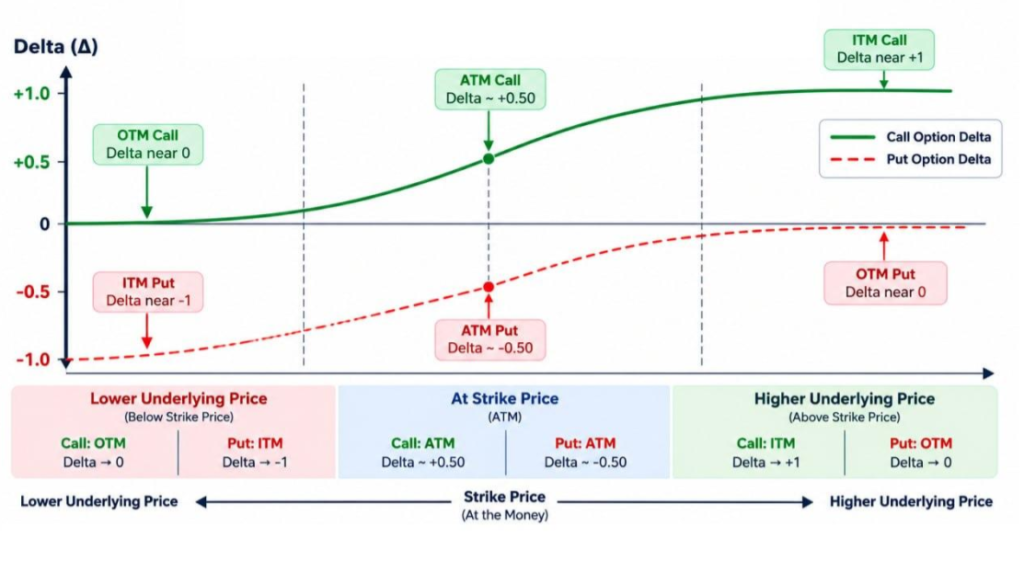
For example, if a call option has a delta of 0.50, a ₹1 increase in the underlying asset may increase the option premium by approximately ₹0.50, assuming other factors remain constant. Similarly, a ₹1 decrease in the underlying asset may decrease the option premium by approximately ₹0.50. In practice, the actual change may differ because delta itself changes as market conditions change.
In simple terms, delta tells traders how sensitive an option’s premium is to changes in the price of the underlying asset. It is useful for understanding directional exposure, comparing option contracts, estimating potential premium changes, and managing risk.
Delta helps traders to:
- Understand an option’s price sensitivity.
- Identify bullish or bearish directional exposure.
- Compare different option contracts.
- Estimate potential changes in option premium.
- Manage and hedge portfolio risk.
Option Greeks: Gamma (γ)
Gamma shows how much an option’s delta will change when the underlying asset price increases or decreases by ₹1. In simple terms, gamma measures how fast an option’s sensitivity can change due to movements in the underlying asset price.
In options trading, long call and long put positions typically have positive gamma. It is generally highest for at-the-money (ATM) options and tends to rise significantly as expiration nears, particularly when the option is close to its strike price. While delta is positive for call options and negative for put options, gamma is typically positive for both long calls and long puts. Traders holding short call or put positions typically experience negative gamma.
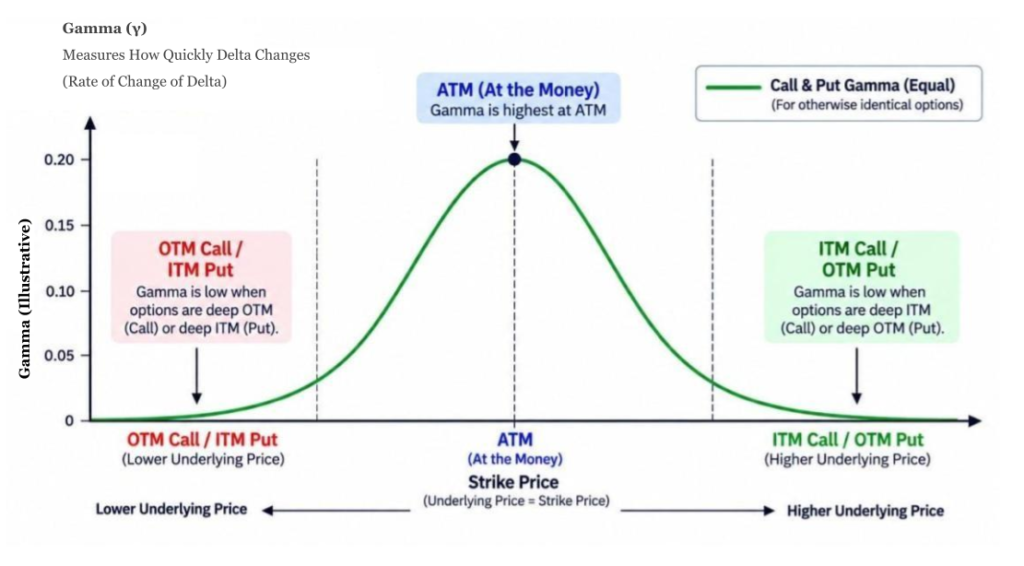
Let’s take an example where a call option has a delta of 0.50 and a gamma value of 0.05. When the underlying asset price increases by ₹1, the option’s delta may move from approximately 0.50 to 0.55. Similarly, if the underlying asset price falls by ₹1, the delta may decrease from approximately 0.50 to 0.45.
The approximate change in delta can be understood using the formula:
| Change in delta = gamma x change in underlying price |
Therefore,
0.05 x 1 = 0.05
As a result, gamma helps traders understand how rapidly delta changes when the underlying asset moves. This makes understanding gamma essential for effective risk management, delta hedging, and option selling strategies.
Gamma is valuable for:
- Managing portfolio and hedging risk
- Analysing changes in option delta
- Evaluating gamma exposure in near-the-money options
- Evaluating how quickly an option’s exposure can change
- Managing delta neutral strategies
Option Greeks: Theta (θ)
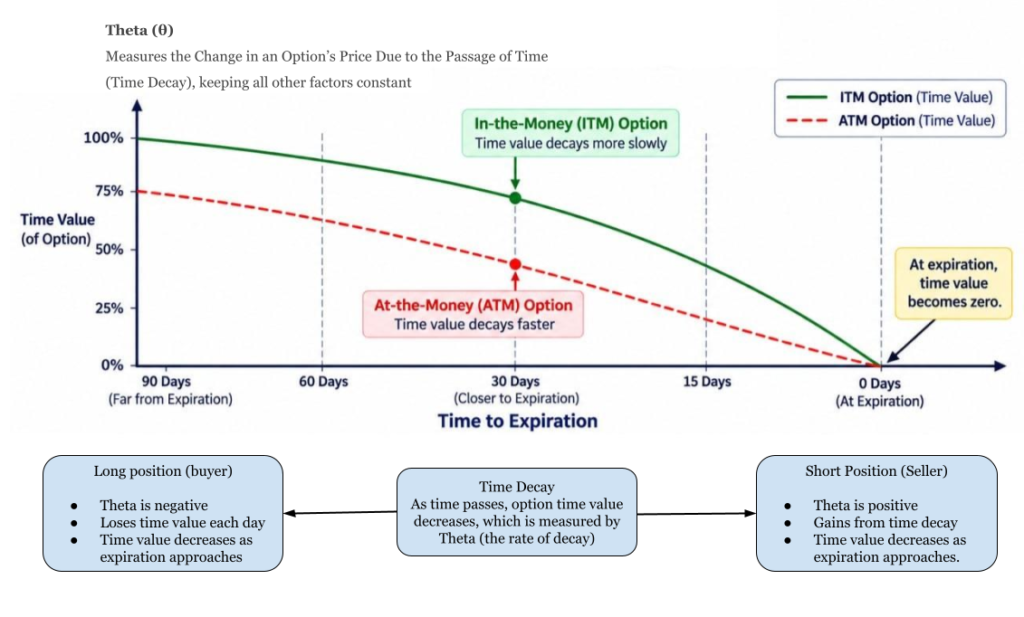
Among the important option Greeks, theta measures how time decay influences an option’s premium. It helps to determine how much an option’s value may change over time when all other factors remain unchanged. In simple terms, theta measures how much an option may decline in value as time passes toward its expiration date.
Option buyers typically experience negative theta as the value of a long option decreases over time as expiration gets closer. Conversely, option sellers usually gain from time decay, so theta is generally positive for short positions. Therefore, time decay generally works against option buyers while benefiting option sellers, assuming all other factors remain unchanged.
Theta is an important concept because the value of an option is affected by time decay throughout its limited lifespan. Time decay typically has a greater impact as an option gets closer to expiration, although its effect depends on factors such as moneyness, implied volatility, and remaining time.
Therefore, the rate of time value erosion may increase significantly as an option gets closer to expiry. Option buyers need to pay close attention to theta because the underlying asset may need to move enough in the expected direction to offset the decline in value resulting from time decay.
Key features of theta:
- Measures the effect of time decay on an options premium.
- Short options generally carry a positive theta value.
- Negative theta is commonly associated with buying call and put options.
- ATM options typically have a higher absolute theta compared with ITM and OTM options, particularly near expiration.
- Options tend to experience faster time decay as they move closer to expiration, especially when they are near the money.
Option Greeks Vega (v)
Vega shows how much an option’s premium can change when the implied volatility (IV) of the underlying asset changes. In option pricing, delta measures sensitivity to the underlying asset’s price, theta measures the impact of time decay, and Vega measures how changes in implied volatility affect the option’s premium.
Higher implied volatility generally reflects greater expected price movement, which tends to increase the premiums of both call and put options. When implied volatility falls, option premiums typically decrease if other market conditions remain constant. Vega generally remains positive for both call and put options.
Vega shows how much an option’s premium is expected to change approximately when implied volatility moves by 1 percentage point, while other variables remain constant. For example, if an option has a Vega of ₹0.20, a rise in implied volatility from 20% to 21% may increase the option premium by approximately ₹0.20, while a fall from 20% to 19% may decrease the premium by approximately ₹0.20.
It plays an important role during earnings announcements, key economic data releases, elections, and other market-moving events where implied volatility can fluctuate quickly. After major events, implied volatility can drop sharply, which may lead to lower option premiums even without significant movement in the underlying asset. This phenomenon is commonly known as an IV crush.
It is typically highest for at-the-money (ATM) options and lower for deep in-the-money (ITM) and deep out-of-the-money (OTM) options. Vega is generally higher for options with longer time to expiration, meaning changes in implied volatility can have a greater impact on their premiums.
Key factors that affect vega:
- Strike price: Vega may vary for different strike prices because each strike represents a different level of moneyness.
- Moneyness: At-the-money (ATM) options typically have greater Vega compared with deep ITM or deep OTM options.
- Time to expiration: Longer-term options usually have higher Vega because volatility has more time to influence their value.
- Market conditions: When market uncertainty rises, changing volatility expectations can significantly influence the value of option premiums.
- Implied volatility (IV): Changes in IV can affect both Vega and the option premium.
Option Greeks: Rho (⍴)
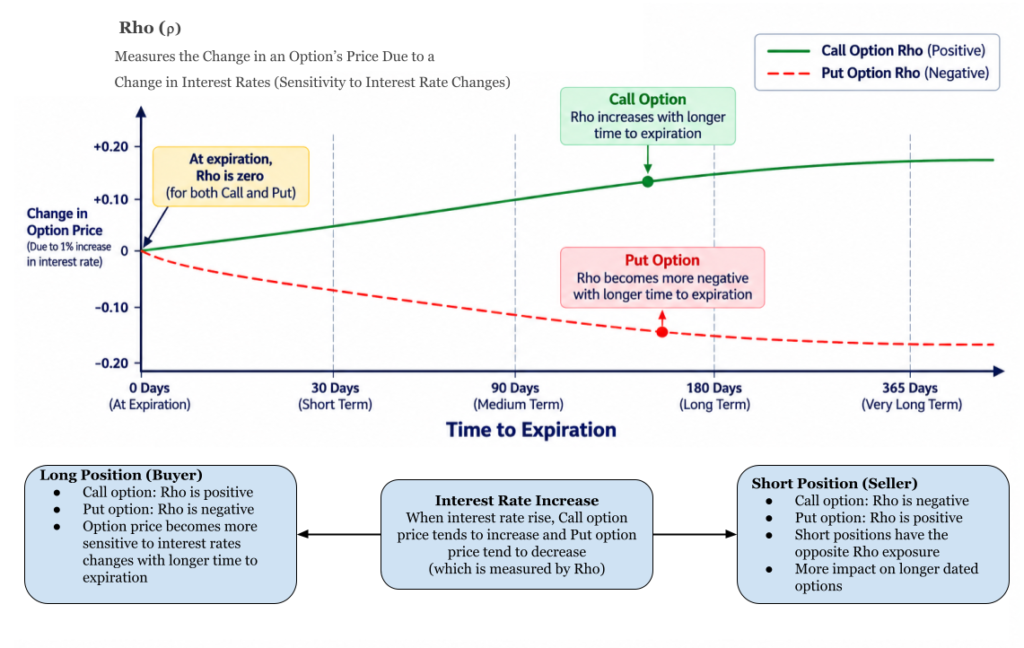
Rho (⍴) determines how changes in interest rates can affect an option’s premium. It shows approximately how much an option’s price may change when the interest rate moves by 1 percentage point, with all other factors remaining constant.
Rho is generally positive for call options and negative for put options. Therefore, a rise in interest rates generally increases the value of a call option and decreases the value of a put option.
For example, if the rho value of a call option is 0.40, a 1 percentage point rise in interest rates could increase its premium by about ₹0.40 per option unit. Likewise, if a put option has a rho of -0.30, a 1 percentage point increase in interest rates may reduce its premium by about ₹0.30 per option unit.
Short-term options are typically less sensitive to rho because there is less time for changes in interest rates to influence their value. However, Rho may have a greater impact on long-term options because interest rate changes can affect their premiums more significantly.
Comparison Table Of Option Greeks
| Option Greek | Measures | Affected By | Call | Put |
| Delta (Δ) | Change In Option Price For A Change In Underlying Price | Underlying Price | Positive | Negative |
| Gamma (γ) | Change In Delta For A Change In Underlying Price | Underlying Price | Positive | Positive |
| Theta (θ) | Change In Option Price Due To Passage Of Time | Time To Expiry | Negative | Negative |
| Vega (V) | Change In Option Price Due To Implied Volatility | Implied Volatility | Positive | Positive |
| Rho (⍴) | Change In Option Price Due To Interest Rate Changes | Interest Rates | Positive | Negative |
FAQ’S
Option Greeks are important because they help traders to understand and manage the factors that affect an option’s price.
The five primary option Greeks are delta, gamma, theta, Vega, and rho, which measure different factors affecting an option’s price.
Delta is the primary option Greek used to measure an option’s sensitivity to changes in the underlying asset price.
Option Greeks show how changes in price, time, volatility, and interest rates can affect an option’s premium.
Yes, option Greeks apply to both call and put options, although their values and effects can differ.
Yes, option Greeks help to estimate how different market factors may affect option prices.
Option Greeks are mainly affected by the underlying price, volatility, time to expiry, interest rates, and strike price.
Positive and negative option Greeks show whether an option’s value generally increases or decreases when market factors change.
Disclaimer
This article is for educational and informational purposes only and should not be considered financial, investment, trading, legal, or tax advice. Cryptocurrency, blockchain, stock markets, and other financial investments involve risks. Always conduct your own research and consult a qualified financial advisor before making any investment decisions.
