


In options trading, volume and open interest (OI) are two key indicators that help traders to understand market activity and the positions held by market participants. Despite being related to options contracts, each measures a different aspect of market activity. Volume indicates how many contracts are traded over a given period, whereas open interest shows the total number of outstanding contracts that have not been closed or settled. Volume reflects the level of trading activity, whereas open interest shows the total number of active contracts in the market. The distinction between volume and open interest helps traders to understand market activity, observe changes in options positioning, and evaluate liquidity across multiple strike prices.
Volume In Option Trading
Volume refers to the total number of option contracts exchanged between buyers and sellers during a specific period. It indicates the level of trading activity in a particular call or put option, helping traders assess how frequently the contract is traded.
Each time an option contract is traded between a buyer and a seller, the volume increases. For example, if 600 contracts of a particular call option are traded during a trading session, the volume is 600 contracts. If another 200 contracts are traded later in the same session, the total volume increases to 800 contracts.
Volume is calculated separately for each option contract according to its underlying asset, expiry date, strike price, and option type (call or put). Therefore, a call option and a put option with the same strike price and expiry date can have different trading volumes.
By analysing volume, options traders can identify popular contracts, measure trading activity, and evaluate their potential liquidity. High volume generally indicates strong trading activity, whereas low volume may suggest less participation in the market. However, high volume alone does not guarantee high liquidity or indicate whether an option’s price will increase or decrease. Traders should also evaluate the bid-ask spread, market depth, option premium, and the underlying asset’s price movements.
Price And Volume Relationship In Option Trading
Comparing an option’s premium with its trading volume helps traders to understand how trading activity changes over time. However, volume should be used in conjunction with price action and other market indicators instead of being considered an independent trading signal.
| Option Premium (Price) | Volume | Possible Implication |
| Rising ↑ | Increasing ↑ | Bullish Momentum May Be Strengthening |
| Rising ↑ | Decreasing ↓ | Rising Premium With Weaker Trading Activity |
| Falling ↓ | Increasing ↑ | Bearish Momentum May Be Strengthening |
| Falling ↓ | Decreasing ↓ | Falling Premium With Weaker Trading Activity |
Open Interest (OI) In Option Trading
Before learning about open interest, we should first understand what open interest is and how it differs from volume in options trading. Volume applies to almost every tradable financial instrument in the market, including equities, commodities, currencies, bonds, and their derivatives. However, open interest (OI) applies specifically to outstanding futures and options contracts derived from these underlying assets. Open interest is commonly used by traders to validate market trends and identify possible reversals, much like volume. However, it differs from volume and applies only to futures and options contracts.
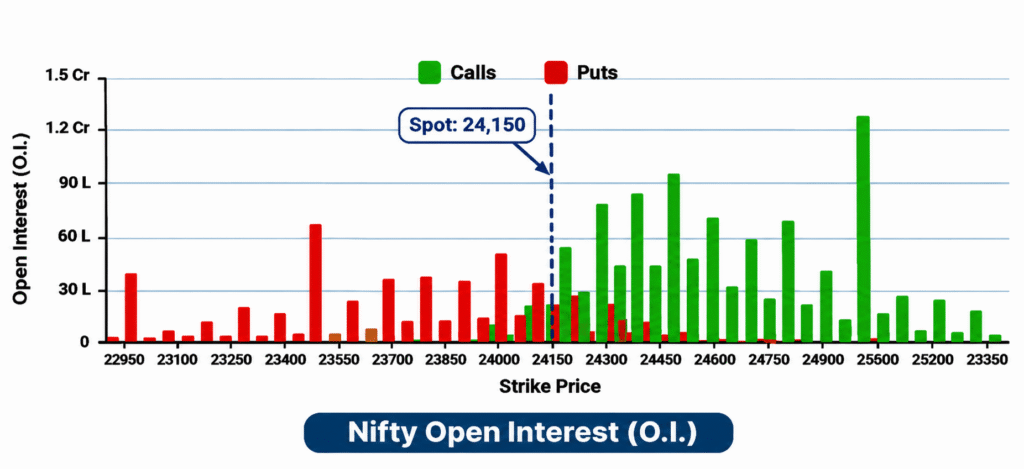
Open interest (OI) in the options market represents the cumulative number of outstanding contracts that remain active until they are closed, exercised, or expire. It helps traders to determine the total number of outstanding contracts associated with a specific underlying asset, strike price, expiry date, and option type.
Open interest increases when both the buyer and seller initiate new positions and decreases when both parties exit their existing contracts. It remains unchanged when one market participant opens a new position, and another market participant closes an existing position.
For example, if traders create 500 new call option contracts for a particular strike price and expiry date, open interest increases by 500 contracts. If 200 existing contracts are subsequently closed by both parties, open interest decreases by 200 contracts, assuming no other changes occur.
Traders commonly use it to analyse market participation, position buildup, and potential support and resistance levels. However, it does not directly indicate whether traders are bullish or bearish. To interpret market activity effectively, traders should evaluate OI alongside changes in option premium, trading volume, and the underlying asset’s price. It can help to identify potential support and resistance levels, but these levels do not guarantee that prices will reverse or stop.
Price, Volume And Open Interest (OI) Implications
By evaluating price changes, trading volume, and open interest together, traders can analyze market activity and identify signs of possible trends. This combination helps to identify whether traders are opening new positions or closing existing ones.
Price Movement | Volume | Open Interest Change | Possible Interpretation |
| Rising | Rising | Rising | Long Buildup: Potential Bullish Sentiment |
| Falling | Rising | Rising | Short Buildup: Potential Bearish Sentiment |
| Rising | Rising | Falling | Short Covering: Existing Short Positions May Be Closing |
| Falling | Rising | Falling | Long Unwinding: Existing Short Positions May Be Closing |
Volume Vs Open Interest (OI): Understanding The Key Differences
| Basis Of Comparison | Volume | Open Interest (OI) |
| Definition | The Total Number Of Option Contracts Traded During A Specific Period | The Total Number Of Option Contracts That Remain Open And Outstanding |
| Changes In Volume And Open Interest | Increases With Every Executed Trade, Regardless Of Whether It Involves New Or Existing Positions | Increases When Both Parties Open Positions, Decreases When Both Parties Close Positions, And Remains Unchanged When One Party Opens And The Other Closes |
| Time Based Measurement | Measures The Number Of Option Contracts Traded Over A Specific Period, Such As One Trading Day | Represents The Total Number Of Option Contracts That Remain Open At A Particular Moment |
| What It Represents | High Volume Indicates Increased Trading Activity But Does Not Confirm The Direction Of Price Movement | High OI Indicates A Large Number Of Outstanding Contracts But Does Not Confirm Bullish Or Bearish Market Sentiment |
| Trading Behavior | Helps To Evaluate Trading Activity And Potential Price Momentum | Helps To Identify Position Buildup And Unwinding, Which May Provide Clues About Potential Support And Resistance Zones When Used With Other Data |
| Example | If 1,000 Option Contracts Are Traded During A Trading Day, The Volume Is 1,000 | If 5,000 Option Contracts Remain Open At The End Of The Trading Day, The Open Interest Is 5,000 |
FAQ’S
Answer: Volume measures the total number of option contracts traded during a specific period, while open interest (OI) represents the total number of outstanding option contracts that have not been closed, exercised, or settled.
Answer: Rising open interest (OI) means more option contracts are open in the market, but it does not always indicate whether the market is bullish or bearish.
Answer: No, high volume does not necessarily mean high open interest because contracts can be traded repeatedly without increasing the total number of outstanding contracts.
Answer: Volume and open interest can help traders identify market trends by analyzing trading activity and changes in active contracts, but they cannot predict market direction accurately on their own.
Answer: High volume and high open interest in option trading indicate strong trading activity and significant market participation, but they do not independently confirm whether the market will move bullish or bearish.
Disclaimer
This article is for educational and informational purposes only and should not be considered financial, investment, trading, legal, or tax advice. Cryptocurrency, blockchain, stock markets, and other financial investments involve risks. Always conduct your own research and consult a qualified financial advisor before making any investment decisions.
