


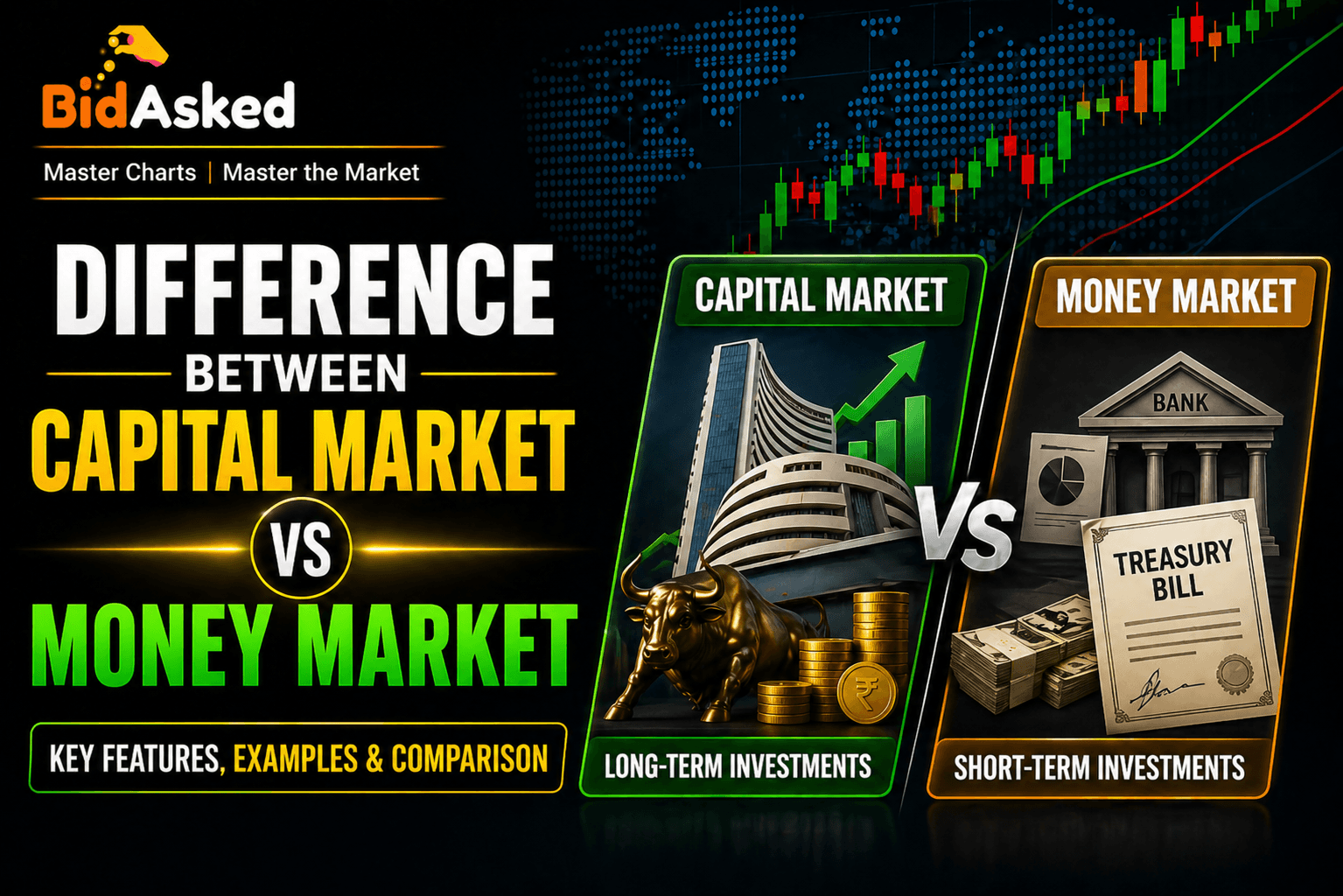
Before understanding the concept of the capital market and the money market, it is essential to first understand the financial market. The economic progress of any country largely depends on the effectiveness of its financial system. A financial market is a broad system where where buyers and sellers come together to trade financial instruments such as stocks, bonds, commodities, derivatives, currencies. Financial markets consist of various components, among which the capital market and money market are two important part of financial system. Both markets facilitate the flow of funds & support economic activities, but they are distinct in their purpose, financial instruments, maturity period, risk levels, and participants.
A clear understanding of the differences between the capital market and the money market helps investors and market participants align their investment decisions with their financial objectives. The capital market and money market jointly contribute to the financial system by complementing each other. While the capital market contributes to long term economic expansion by investing in productive sectors, the money market maintains short term liquidity and financial stability through efficient fund management.
Capital market
The capital market is a segment of the financial market where long term securities such as equities, bonds, and debentures are bought and sold. It provides a platform through which companies and governments raise funds for expansion, modernization, and long term development projects. The capital markets plays an important economic role by pooling savings from individuals and institutions and investing them in long term productive assets. Capital market investors usually look for price appreciation, dividend returns, and sustained long term wealth creation.
Due to changes in economic conditions, company performance, and market sentiment, capital market investments tend to involve higher risk. However, it also offers the potential for higher returns over the long term. The capital market is further divided into the primary market and the secondary market. The primary market is where new securities are issued for the first time, whereas the secondary market is where existing securities are traded among investors.
Primary market
The primary market is also known as the new issue market, where new securities are issued by companies and sold directly to investors for the first time. In the primary market, companies raise fresh capital to meet various objectives such as business expansion, debt repayment, or funding new projects. In this market, securities are not bought and sold on stock exchanges; instead, funds are transferred directly from investors to the issuing company. An initial public offering (IPO) is a common example of the primary market.
The primary market act as a gateway through which new securities are introduced into the capital market in a regulated and organized framework. Funds generated in this market are primarily allocated to long term activities such as expansion, infrastructure development, and investment, enabling the primary market to drive capital formation & sustainable growth.
Another key function of the primary market is helping to establish the initial valuation of newly issued securities. Using fixed price issues and book building process, the capital market sets a fair issue price reflecting investor demand, company growth potential, and current market conditions. The price set initially act as the foundation for ongoing transactions in the secondary market.
Secondary market
In the secondary market, buying & selling of securities occur via organized platforms like stock exchanges or over the counter (OTC) systems. The secondary market is commonly referred to as the after issue market. Securities that have already been issued are bought & sold by investors in the secondary market. In these transactions, the issuing company has no direct role, since the transfer of funds takes place between buyers & sellers of existing securities. The secondary market enhances the overall efficiency of capital allocation within the financial system. Companies that demonstrate strength & future growth tend to achieve higher valuations, while weaker firms lose market value. Continuous price assessment and evaluation enhance corporate accountability while ensuring efficient management of economic resources.
Money market
The money market refers to a financial market where lending and borrowing of short-term debt instruments take place, typically with maturities of one year or less. It plays an important role by providing short-term financing to governments, financial institutions, and companies. In the money market, securities generally have maturities ranging from overnight or one week up to one year.
Money markets are popular among investors due to their low-risk nature and high liquidity. The money market includes short-term instruments such as treasury bills (T-BILLS), commercial paper, certificates of deposit (CDs), and repurchase agreements (REPOS). The activities in the money market are regulated and supervised by the central bank, which ensures stability, liquidity, and smooth functioning of the financial system.
Comparison table between capital market and money market
| Sr. No. | Feature | Capital Market | Money Market |
| 1 | Purpose | Provides Long-Term Financing For Business Expansion, Infrastructure, & Economic Development | Provides Short Term Financing And Liquidity To Meet Working Capital Needs |
| 2 | Investment Duration | Long Term Maturity, More Than One Year | Short Term Maturity, Less Than One Year |
| 3 | Securities Traded | Equity Shares, Bonds, Debentures, Preference Shares, Etc | Treasury Bills (T-Bills), Commercial Papers, Certificate Of Deposit (CDs), Etc |
| 4 | Participants | Companies, Stock Brokers, Institutional Investors, Retail Investors, Goverment | Central Bank, Commercial Bank, Financial Institutions, Mutual Funds |
| 5 | Liquidity | Comparatively Less Liquid Than Money Market | Highly Liquid Market |
| 6 | Risk Level | Higher Risk Due To Long Term Exposure & Market Volatility | Lower Risk Due To Short Maturity Period |
| 7 | Return On Investment (ROI) | Higher Potential Returns | Lower But More Stable Returns |
Conclusion
The capital market & the money market are both integral part of the financial system. Although they are closely interrelated, they serve distinct purposes within the economy. The capital market primarily focuses on long term investments & capital formation, supporting economic growth while the money market deals with short term liquidity & financing needs, ensuring smooth functioning of the financial system. Together, both markets play a important role in maintaining overall economic stability & development.
FAQ’S
Answer: The capital market is used for long term investments like shares and bonds, while the money market is used for short term borrowing and lending for quick cash needs.
Answer: Examples of capital market instruments are shares, bonds, debentures, government securities, mutual funds, and ETFs, which are used for long term investment and wealth creation.
Answer: Money market instruments include treasury bills (T-bills), commercial papers, certificates of deposit (CDs), call money, and repurchase agreements (REPCO), which are short term, low risk financial instruments used for liquidity management and short duration investments.
Answer: The capital market in India is regulated by the securities and exchange board of India (SEBI), which makes rules to protect investors and ensure fair trading in the stock market.
Answer: The money market in India is regulated by the reserve bank of India (RBI), which controls liquidity, interests rates, and short term credit through monetary policy tools to ensure financial stability.
Answer: Capital markets are two types, primary market where companies issue new shares to raise money, and secondary market where investors buy and sell existing shares.
Answer: The capital market has higher risk and higher returns than the money market because it deals with long term investments like shares that can rise or fall more.
Answer: Liquidity is higher in the money market because funds can be easily and quickly converted into cash, while the capital market has lower liquidity as it deals with long term investments like shares and bonds.
Disclaimer
This article is for educational and informational purposes only and should not be considered financial, investment, trading, legal, or tax advice. Cryptocurrency, blockchain, stock markets, and other financial investments involve risks. Always conduct your own research and consult a qualified financial advisor before making any investment decisions.
