


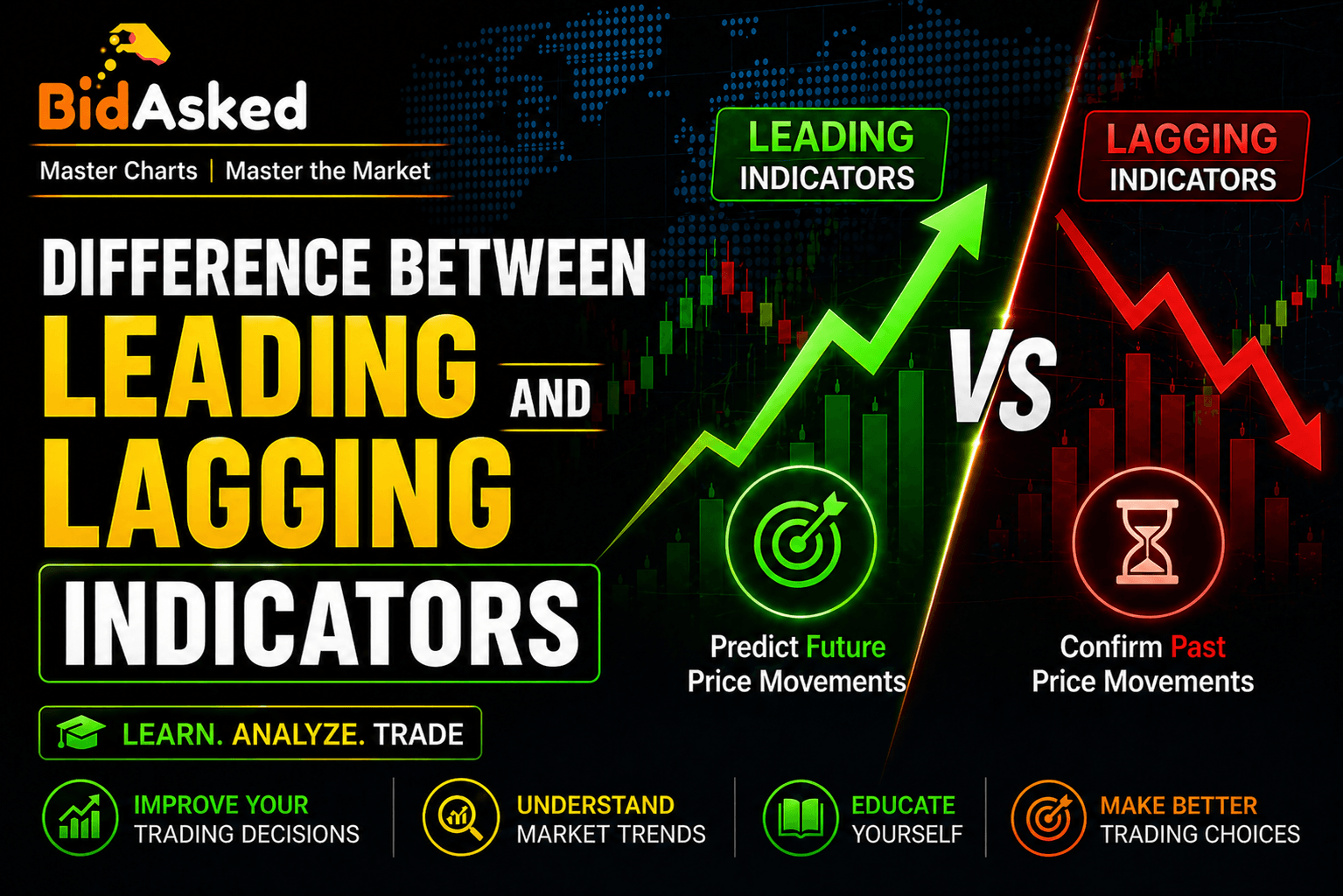
Technical indicators are analytical tools that help traders to forecast future price direction based on past price movements in stocks, currencies, and commodities.
They are a key component of technical analysis, assisting traders and investors in identifying the right moments to buy or exit positions to achieve higher profitability.
Technical indicators help market participants to analyze price behaviour, momentum shifts, trend direction, and potential reversals. Traders who apply indicators without distinguishing between leading and lagging ones often fall into the trap of entering trades blindly, resulting in poor outcomes and false indications. Recognizing how indicators work and using them according to their role in trading can significantly enhance overall trading performance.
It is essential to recognize that the stock market functions mainly on speculation and probability, where a few participants earn consistently while most incur losses. This makes it clear that technical indicators are inherently imperfect, and their true value lies in assisting analysis rather than predicting price movements.
By understanding technical indicators, traders can better interpret market signals and make informed trading decisions. This article explains the concept of technical indicators and clearly differentiates between leading indicators that predict price movements and lagging indicators that validate ongoing trends.
Broadly, technical indicators are classified into two main categories:
- Leading indicators
- Lagging indicators
Leading indicator
Leading indicators are specially designed to predict early price movements. They signal trading opportunities before a trend becomes clearly established. Since these indicators respond rapidly to price movements, they produce more trading signals and create additional opportunities. While it reacts faster, it also increases the probability of misleading or false signals. Leading indicators aim to predict future price action by studying momentum, volume, and extreme levels, typically oscillating between 0 & 100.
Key characteristics of leading indicators are
1) Early market trend signal
Leading indicators provide early trade signals by identifying possible buy & sell opportunities before a significant price movement begins.
2) High responsiveness to price changes
These indicators swiftly adjust to minor market movements, making them ideal for early momentum detection.
3) Overbought & oversold zone detection
By signaling extreme market conditions, leading indicators help traders to spot overbought and oversold zones where prices may be overextended and likely to reverse or correct.
4) Performance in sideways or range bound markets
Leading indicators perform best during sideways or consolidating phases, where price moves within a defined range rather than following a strong trend.
5) Higher possibility of false signals
As leading indicators are designed to anticipate future moves, they often give premature or misleading signals in strong trends, highlighting the importance of confirmation.
Some of the most popular leading indicators include the relative strength index (RSI), stochastic oscillator, william % R, and the commodity channel index (CCI), as they help traders anticipate potential price reversals.
Relative strength index (RSI)
The relative strength index (RSI) is one of the most popular momentum indicators used by traders to analyze market strength. It measures momentum by comparing a stocks recent gains and losses and converts this data into a value ranging from 0 to 100, meaning the RSI oscillates between these two levels. According to theory, RSI levels exceeding 70 indicate potential overbought conditions, while levels under 30 point to possible oversold conditions.
An overbought RSI level (above 70) signals that buying momentum is strong and and prices may be extended, where traders often consider profits booking or partial profit taking, especially if other indicators support weakness. In the same way, an RSI reading below 30 indicates excessive selling pressure, prompting traders to look for possible buying opportunities, ideally supported by price action or trend confirmation.
Lagging indicators
By studying historical price data, lagging indicators validate existing market trends and issue trading signals once the trend is clearly developed. These are trend following indicators that track the existing trend rather than predicting reversals. As a result, they often generate late buy and sell signals compared to leading indicators, which may cause traders to miss early opportunities. However, this delay is not always a drawback, as it helps eliminate short term volatility and market noise, enabling traders to concentrate on high probability trend based opportunities.
Traders who use lagging indicators in a well defined trending market and stick to the trend can generate steady and dependable profits. These indicators allow traders to remain aligned with the trend for extended periods and capture a significant portion of the price movement. By validating the ongoing trend, they motivate traders to maintain profitable positions instead of closing them prematurely during slight corrections. The biggest limitation of lagging indicators is their slow reaction to price movements, making them less useful in sideways or range bound markets.
Common examples of lagging indicators are
1) Moving averages
2) Moving average convergence divergence (MACD)
3) Average directional index (ADX)
4) Parabolic SAR
Benefits of lagging indicators
1) Reduce emotional trading by confirming trends
2) Filter out short term price noise
3) Help traders remain in profitable trades for a longer duration
4) Ideal for swing trading and positional trading
5) Provide clear buy/sell confirmation signals
Drawback of lagging indicators
1) Late entry & exit signals
2) Miss early trend opportunities
3) Reduced effectiveness in sideways markets
4) Less effective when used for short term scalping
Table:- differences between leading and lagging indicators
| Sr. No. | Aspect | Leading Indicators | Lagging Indicators |
| 1 | Definition | Indicators That Attempt To Predict Future Price Movements Before A Trend Begins | Indicators That Confirm A Trend After It Has Already Developed |
| 2 | Signal Timing | Provide Early Signals Ahead Of Price Action | Provide Delayed Signals After Price Action Occurs |
| 3 | Nature | Predictive In Nature & Focused On Anticipation | Confirmatory In Nature & Focused On Validation |
| 4 | Reaction Speed | React Quickly To Price Changes & Market Momentum | React Slowly Because They Depend On Historical Price Data |
| 5 | Accuracy | Lower Accuracy Due To False Or Premature Signals | Higher Accuracy With Fewer False Signals |
| 6 | Best Market Condition | Perform Better In Sideways, Range Bound, Or Volatile Markets | Perform Best In Strong Trending Market (Uptrend/Downtrend) |
| 7 | Trading Objective | Capture Early Price Movements | Stay Aligned With The Prevailing Trend |
| 8 | Trader Type | Preferred By Aggressive Traders & Short Term Traders | Preferred By Conservative Traders And Trend Followers |
| 9 | Examples | RSI, Stochastic Oscillator, Momentum Indicators | Moving Average, MACD, ADX |
Conclusion
In conclusion, traders who understand the distinction between leading and lagging indicators are better equipped to make informed market decisions. Both indicators serve different purposes and highlight separate aspects of market behaviour, with neither being inherently better than the other. Their core strength is revealed when traders apply them wisely in the right market scenarios.
Leading indicators are forward looking that predict price movements by quickly adapting to changes in momentum, sentiment, and overbought or oversold levels. On the other hand, lagging indicators focus on confirmation by providing signals only after a trend is firmly established, and help traders to identify the overall market direction and trade in line with it. However, the value of leading and lagging indicators is determined by the traders overall approach, market situation, and risk management style.
FAQ’S
Answer: Leading indicators give early signals of possible future price movements, while lagging indicators confirm trends only after the price movement has already happened, helping traders to validate market direction.
Answer: Lagging indicators are better for beginners because they are easier to understand, simple to use, and help to confirm existing market trends.
Answer: Yes, leading and lagging indicators can be used together to get better trade confirmation and improve decision making.
Answer: RSI, stochastic oscillator, and Williams %r are common leading indicators.
Answer: Moving averages, MACD, and Bollinger bands are popular lagging indicators.
Disclaimer
This article is for educational and informational purposes only and should not be considered financial, investment, trading, legal, or tax advice. Cryptocurrency, blockchain, stock markets, and other financial investments involve risks. Always conduct your own research and consult a qualified financial advisor before making any investment decisions.
