


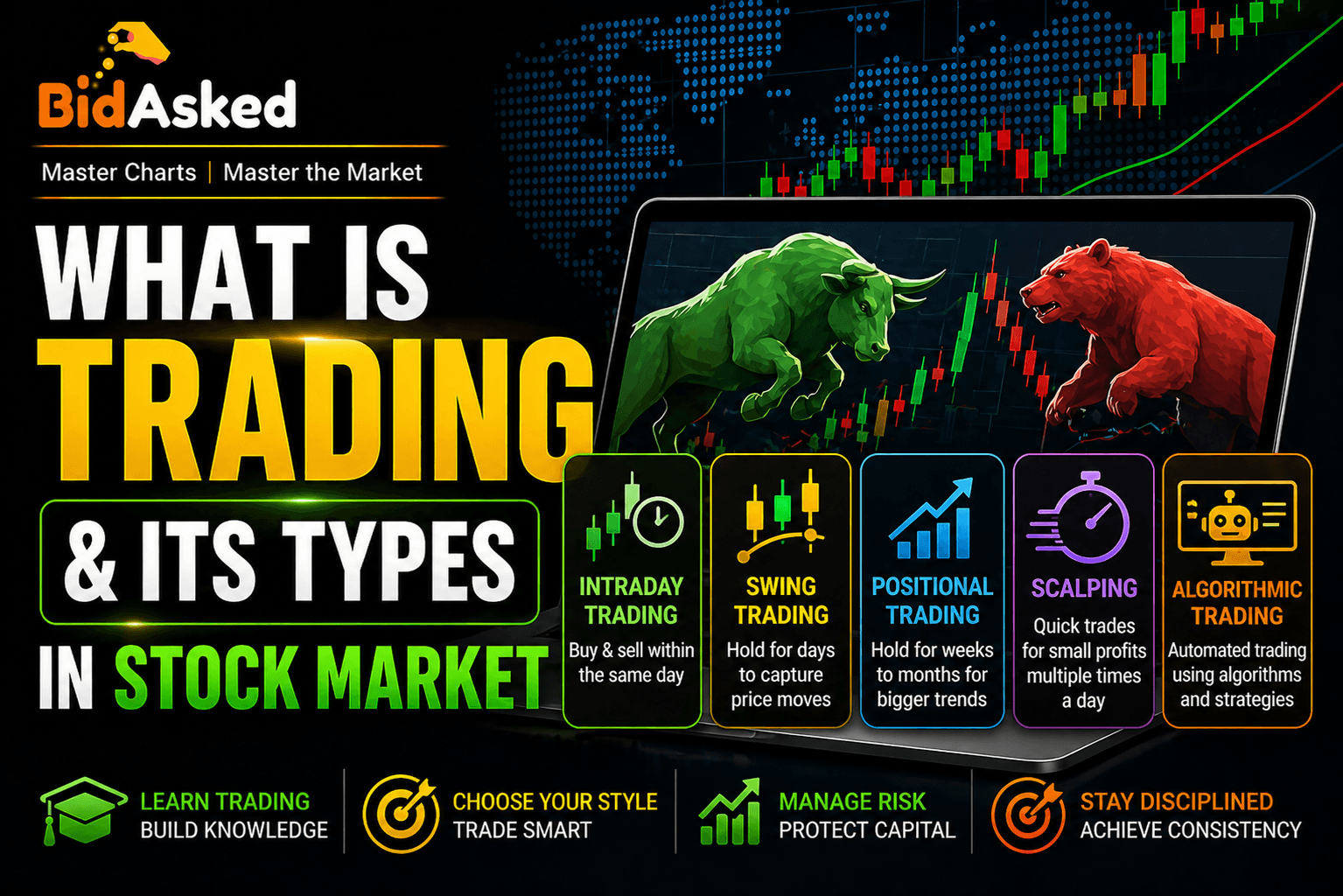
Trading is one of the most important activities in the stock market, where market participants buy and sell financial instruments such as shares, indices, derivatives, or commodities with the objective of earning profits from price movements. While long term investing focuses on gradual wealth accumulation, trading generally aims to capitalize on short term to medium term price fluctuations and heavily depend on market timing, price action, and technical analysis.
The primary objective of traders is to leverage market dynamics by timing their entries and exits based on momentum, volume, patterns, and trends. Depending on the strategy applied, trading may last for a few minutes, several hours, days, or even weeks. A clear understanding of trading and its types helps investors to adopt methods that fit their goals, risk capacity, and availability. Every trading style fits a specific group of market participants based on their investment capital, experience level, and time availability.
Stock market trading categories trading in the stock market falls into various categories depending on time frame, position duration, and approach. Every category comes with distinct features, benefits, and potential drawbacks. Here are the key trading types used in the stock market:
Positional Trading
Positional trading is a long term trading strategy in which traders hold positions for several days, weeks, months, or even years to capture major market trends. This strategy is suitable for investors who prefer lower short term volatility, minimal trading activity, and a more relaxed approach to market participation. Positional traders aim to benefit from complete market cycles and long term price movements rather than short term fluctuations. Higher time frames such as weekly and monthly charts play an important role in positional trading for identifying long term trends and market direction. By analyzing support and resistance zones and applying key moving averages such as the 50 day & 200 day, traders can determine the long term trend direction.
It requires basic knowledge of both fundamental and technical analysis, along with a proper risk management strategy. A key aspect of positional trading is fundamental analysis, where stocks are selected based on strong financials, consistent earnings growth, solid business models, and favorable sector and industry trends.
This approach is generally less stressful compared to intraday or short term trading, as it does not require constant monitoring of price movements throughout the trading day. In positional trading, traders focus on identifying strong and well established trends and remain invested until the trend shows clear and confirmed signs of reversal. Since positions are held for an extended period, this type of trading is less influenced by short term market volatility, but it requires patience, discipline, and emotional strength to handle temporary price swings.
Advantage
- Fewer trades, which means lower transaction costs
- Potential for higher returns by capturing long term trends
- Positional trades give lower stress by comparing to pressure of intraday volatility
Disadvantage
- Patience required to absorb short-term volatility
- Overnight event can disrupt the trends
Swing Trading
Swing trading is a type of trading strategy that aims to capture short to medium term price movements by holding positions for a few days to several weeks. The primary objective of swing trading is to generate profits by taking advantage of price swings in alignment with the overall market or individual stock trends.
Such strategies are preferred by traders who do not want to monitor the market continuously but still wish to participate actively. In swing trading, traders primarily depend on technical analysis to identify entry and exit points by using analyzing trends, chart patterns, and momentum indicators. Basic knowledge of fundamental analysis, combined with technical analysis, is also required.
In swing trading, daily charts are most commonly used to filter out short term market noise and provide clearer trend visibility. Additionally, other timeframes such as the 4 hour refer for better timing and weekly charts are used to understand the broader market trend and follow the overall market trend.
Because swing traders hold positions overnight, proper risk management becomes critical to protect against gap up and gap down risks influenced by news, earnings, or worldwide market changes. To manage this risk, swing traders typically use predefined stop loss levels, maintain a favorable risk to reward ratio, and limit the use of leverage.
Advantage
- It is suitable for a part time trader who do not want to monitor market constantly
- Compared to day trading, it requires less attention and less trades
- It gives considerable profit without long term commitment
Disadvantage
- Overnight event such as earning, geopolitical event disrupt the overall trends
- In choppy market, more chances of early entry and exits which increase potential loss
Day Trading
Day trading, popularly known as intraday trading, is a trading style in which securities such as stocks, indices, or derivatives are bought and sold within the same trading day. The primary objective of day trading is to capitalize on small price movements that occur during market hours, rather than holding positions overnight. Since all positions are closed before the market ends, intraday traders are not exposed to overnight risk such as global events or gap openings.
Day trading strategy is based on intraday price fluctuations, quick execution, and technical analysis and it is often influenced by market events and news. It is one of the most complex trading styles, as day traders heavily depend on real-time market data, advanced charting software, and reliable brokers that provide robust trading platforms. The risks involved in day trading are significant due to high market volatility, which can result in both substantial profits and losses within a short period.
Liquidity and volatility are central to intraday trading strategies, allowing traders to enter and exit positions rapidly with minimal slippage. Volatility is equally important, as price fluctuations create opportunities for intraday profits. Without sufficient movement, it becomes difficult for a day trader to generate meaningful returns after considering brokerage charges and taxes.
Day trading also demands strict discipline and emotional control. Rapid price movements can trigger fear and greed, causing traders to make impulsive moves like overtrading, revenge trading, or neglecting stop loss levels. Professional day traders stick to a predefined trading plan, execute only high probability setups, and treat losses as a normal part of trading.
In day trading, most traders use multi time frame analysis by combining shorter time frames to identify precise entry and exit points, while longer time frames are used to understand the overall intraday trend and market structure. Popular time frames used by day traders are 3-minutes, 5-minute, and 1-hour charts.
From a time based perspective, day trading demands continuous and active involvement in the market. Since constant market observation is required during trading hours, day trading is best suited for individuals who can commit focused time to trading activities. Because of its fast paced nature, day trading has a steep learning curve and is best suited for traders with adequate market knowledge, hands on experience, and a high level of risk tolerance.
Advantage
- In day trading, there are no overnight risks that cause gap up and gap down
- It provide flexibility to traders that trade from anywhere where an internet connection are available
- It give more leverage opportunities for trading
Disadvantage
- It requires constant market monitoring and quick decision making that create high stress and exhausting atmosphere
- Frequent trading as a result high commission fees and other transaction costs
Scalping
Scalping is a high frequency trading strategy that focuses on very short term trade execution, aiming to generate profits from small price movements by executing multiple trades and holding positions for a few seconds to a few minutes. Scalpers prefer highly liquid markets that offer tight spreads and fast execution speed. From a technical analysis perspective, in scalping traders typically use 1-minute, 3-minute, and 5-minute timeframe charts to capture these small price fluctuations. Indicators commonly used in scalping include moving averages, VWAP, RSI, stochastic oscillator, and volume based indicators.
The basic concept of scalping is based on the fact that minor price fluctuations happen repeatedly during the trading session, and scalpers aim to convert these frequent small moves into a significant total profit by placing many trades in a day. Due to the extremely high trading frequency, scalping requires rapid decision making, constant focus, and strong discipline.
Scalping works well for skilled traders who thrive in high speed trading situations and maintain emotional discipline under pressure. This strategy requires minimal transaction costs and a reliable trading system, as executing multiple trades can quickly increase brokerage, taxes, and related charges.
Algorithmic trading
Algorithmic trading is a technique in which computer programs automatically execute trade based on pre-defined algorithms. These algorithms consist of a set of rules and parameters such as price, volume, timing, quantity, and other market conditions.
The primary objective of algorithmic trading is to maximize trading efficiency, reduce human intervention, and execute trades faster and more accurately than manual trading. This type of trading is widely used by institutional investors, hedge funds, and increasingly by retail traders. Algorithmic trading is also commonly known as Algo trading or Automated trading.
Comparison Table
| Sr No. | Feature | Positional Trading | Swing Trading | Day Trading | Scalping | Algorithmic Trading |
| 1 | Trade Holding Periods | Weeks To Year | Days To Weeks | Minutes To Same Day Close | Seconds To Minutes | Milliseconds To Days |
| 2 | Trading Activity | Low ( Few Trades Per Year) | Medium | High | Very High | Very High |
| 3 | Analysis Based On | Primary Fundamental With Technical Analysis | Primarily Technical With Fundamental Support | Technical Analysis | Pure Price Action & Order Flow | Quantitative Models (Eg. Maths, Statistics, AI) |
| 4 | Risk Level | Medium To High | Medium | Very High | High | Medium |
| 5 | Potential Profit | Medium To High | Medium | High | Medium | High |
| 6 | Cost Factor | Low | Medium | High | Very High | Very High |
| 7 | Suitability | Long Term And Part Time Investor | Part Time Traders | Full Time Traders | Full Time Traders | Suitable For Big Institutions And Techie Retail Traders |
FAQ’S
Answer: Trading in the stock market means buying and selling shares to make money from price changes over a short or long period of time.
Answer: The main types of stock market trading are intraday trading, delivery trading, swing trading, positional trading, and scalping.
Answer: Delivery (Long-term) trading is best for beginners because it involves buying quality stocks and holding them for a longer period with lower risk, less stress, and minimal daily monitoring.
Answer: Yes, trading focuses on short term price movements, while investing aims for long term wealth creation.
Answer: Intraday trading carries the highest risk in the stock market because rapid price fluctuations, high leverage, and short time frames can lead to quick and significant losses.
Disclaimer
This article is for educational and informational purposes only and should not be considered financial, investment, trading, legal, or tax advice. Cryptocurrency, blockchain, stock markets, and other financial investments involve risks. Always conduct your own research and consult a qualified financial advisor before making any investment decisions.
