


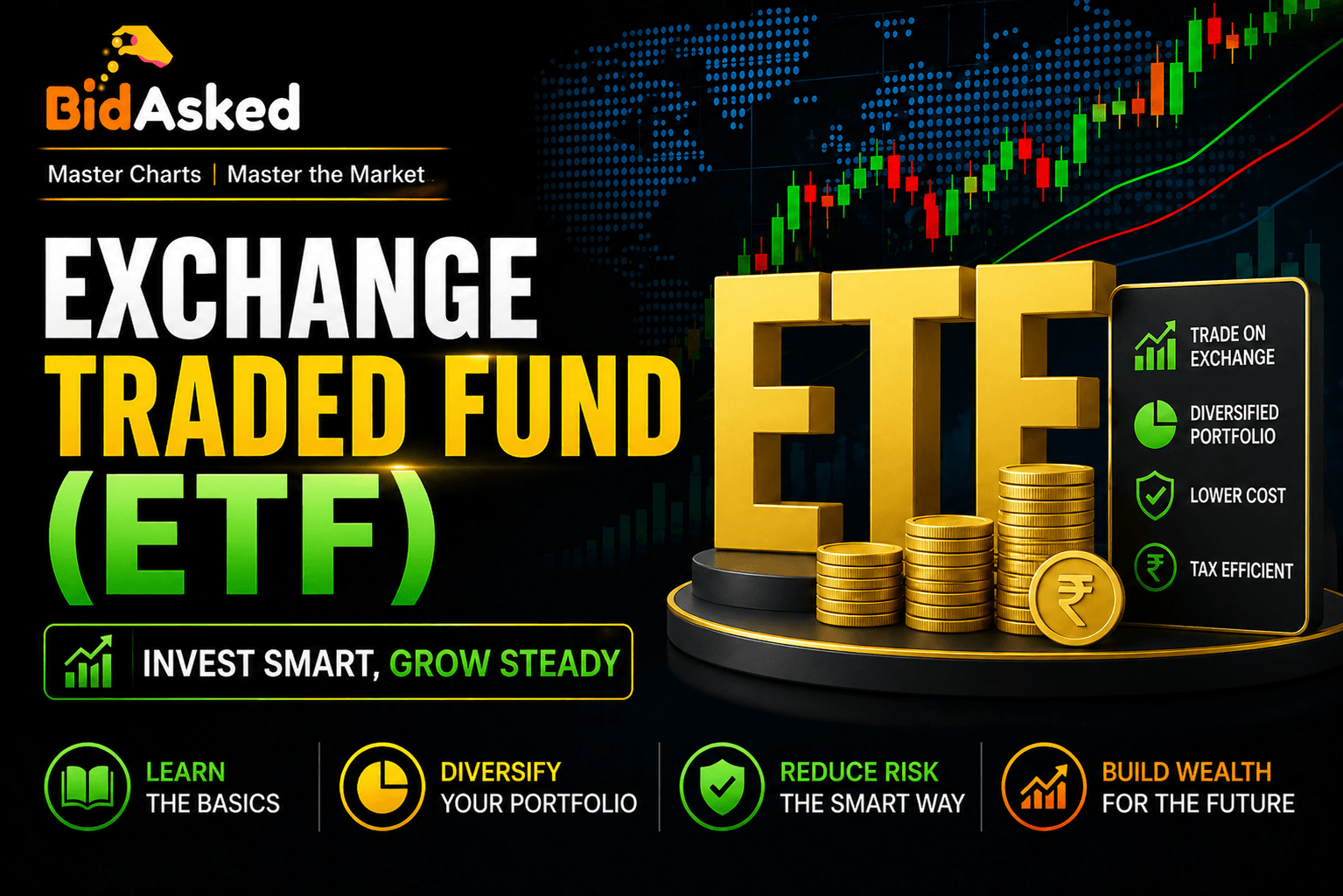
Exchange-traded funds (ETFs) are among the most popular & rapidly expanding investment instruments in today’s financial markets. Exchange traded funds are popularly known as ETFs, are investment instruments manage by asset management companies in which investors pool their money to track an index, commodities, or a basket of underlying assets. ETFs are similar to index funds in the sense that their portfolios reflect the index they track. They deliver the advantages of both mutual funds & shares, allowing investors to enjoy diversification, transparency, flexibility, and cost efficiency in a single product. ETFs can be bought or sold in real-time on stock exchanges at market prices. Investors in exchange-traded funds include both individuals & institutional participants.
Traders can trade exchange traded funds (ETFs) in the same ways as stocks, & allowing them to take both short-term & long-term positions. ETFs can also be traded on an intraday basis & generally it offer high liquidity, similar to stocks. When you buy or sell ETFs, one important thing to remember is that, just like stocks trading, ETFs trading also requires a trading and Demat account for real time buying and selling.
When comparing ETFs to mutual funds, it is important to note that most exchange traded funds (ETFs) are managed passively, whereas mutual funds are generally managed actively. Because ETFs follow a passive investment strategy, they usually have a much lower expense ratio compared to mutual funds. In addition, ETFs typically do not charge any exit load, which further helps in reducing overall investment costs.
Most actively managed mutual funds fails to consistently outperform benchmark indices over the long term. Therefore, exchange traded funds (ETFs), especially index tracking ETFs, can be a good investment choice as they have historically delivered stable long term returns at a relatively lower cost. It offers a flexible & efficient way to invest in a variety of assets by minimizing cost & risk. However, investors should remember that ETFs are subject to market risk, and while choosing an ETFs, high liquidity is an important factor to consider. Exchange traded funds (ETFs) are broadly classified into three main categories:
A) Equity exchange traded funds
B) Debt exchange traded funds
C) Commodity exchange traded funds
Equity ETFs
| Sr.No | Index/Sector Based ETFs | ETFs Name |
| 1 | Nifty-50 | NIFTYBEES, SETFNIF-50, HDFCNIFTY |
| 2 | Nifty Bank | BANKBEES |
| 3 | Sensex | SENSEX-ETF |
| 4 | Nifty Next50 | JUNIORBEES, SETFNN50, NEXT-50 |
| 5 | Midcap100 | MOM-100, LICMID-100 |
| 6 | Nifty100 | HDFCNIF-100 |
| 7 | It Sector | ITBEES, AXISTECETF, IT-ETF |
| 8 | Auto Sector | AUTOBEES |
| 9 | Pharma Sector | PHARMABEES |
Commodity ETFs
| Sr.No | Commodity ETFs | ETFs |
| 1 | Gold | Gold bees |
| 2 | Silver | Silver bees |
Advantage
- Exchange-traded funds generally carry lower risk compared to individual stocks due to diversification, through the risk level depends on the underlying asset class.
- A portfolio becomes more diversified with the inclusion of exchange traded fund.
- If you treat ETFs the same as stocks, so multiple entry and exit are possible.
- Investors do not have to pay any exit load fees while redeeming their investment.
- It has a very low expense ratio.
Disadvantage
- ETFs depend on the performance of the underlying index or assets. If the underlying assets performs poorly, the ETFs value will also decline.
- ETFs may not perfectly replicate the underlying index. As a result, their returns can slightly differ from the index performance due to tracking errors, expenses, or liquidity factors.
Conclusion
Exchange-traded funds (ETFs) offer low cost and diversified investment options with the flexibility of stock trading. While ETFs provide several advantages, investors should also consider potential risks such as low liquidity, market volatility, and tracking errors. Despite these risks, ETFs are becoming increasingly popular due to their versatility, transparency, and efficiency, making them a suitable investment choice for a wide range of investors.
FAQ’S
Answer: An exchange traded fund known as ETF is an investment fund that tracks an index, sector, commodity, or asset and is traded on the stock exchange like a regular share, offering diversification and liquidity at a low cost.
Answer: Yes, ETF can be bought and sold anytime during market hours, as they are traded on stock exchanges like shares, allowing investors to buy or sell them in real time at prevailing market prices.
Answer: Yes, ETFs can be used for intraday trading because they are traded on stock exchanges like shares, offer real time pricing, high liquidity, and allow traders to buy and sell within the same trading day for short term profit opportunities.
Answer: An ETFs can be better than a mutual fund because it offers lower expense ratios, higher liquidity, intraday trading on stock exchanges, and greater transparency, making it suitable for cost conscious and active investors.
Answer: ETFs prices are decided based on the real time market demand and supply on the stock exchange, closely tracking the net asset value (NAV) of the underlying securities they hold.
Answer: Yes, many ETFs pay dividends by distributing the income earned from their underlying stocks or bonds to investors, usually on a quarterly or annual basis, depending on the ETFs type.
Answer: Exchange traded funds (ETFs) in India are managed by SEBI registered asset management companies (AMC), which design, operate, and track the ETFs performance according to its underlying index or asset.
Answer: There are various types of ETFs available in the market, including equity ETFs, debt ETFs, commodity ETFs, sectoral ETFs, gold ETFs, international ETFs, and smart beta ETFs, each designed to track a specific asset class or investment strategy.
Disclaimer
This article is for educational and informational purposes only and should not be considered financial, investment, trading, legal, or tax advice. Cryptocurrency, blockchain, stock markets, and other financial investments involve risks. Always conduct your own research and consult a qualified financial advisor before making any investment decisions.
